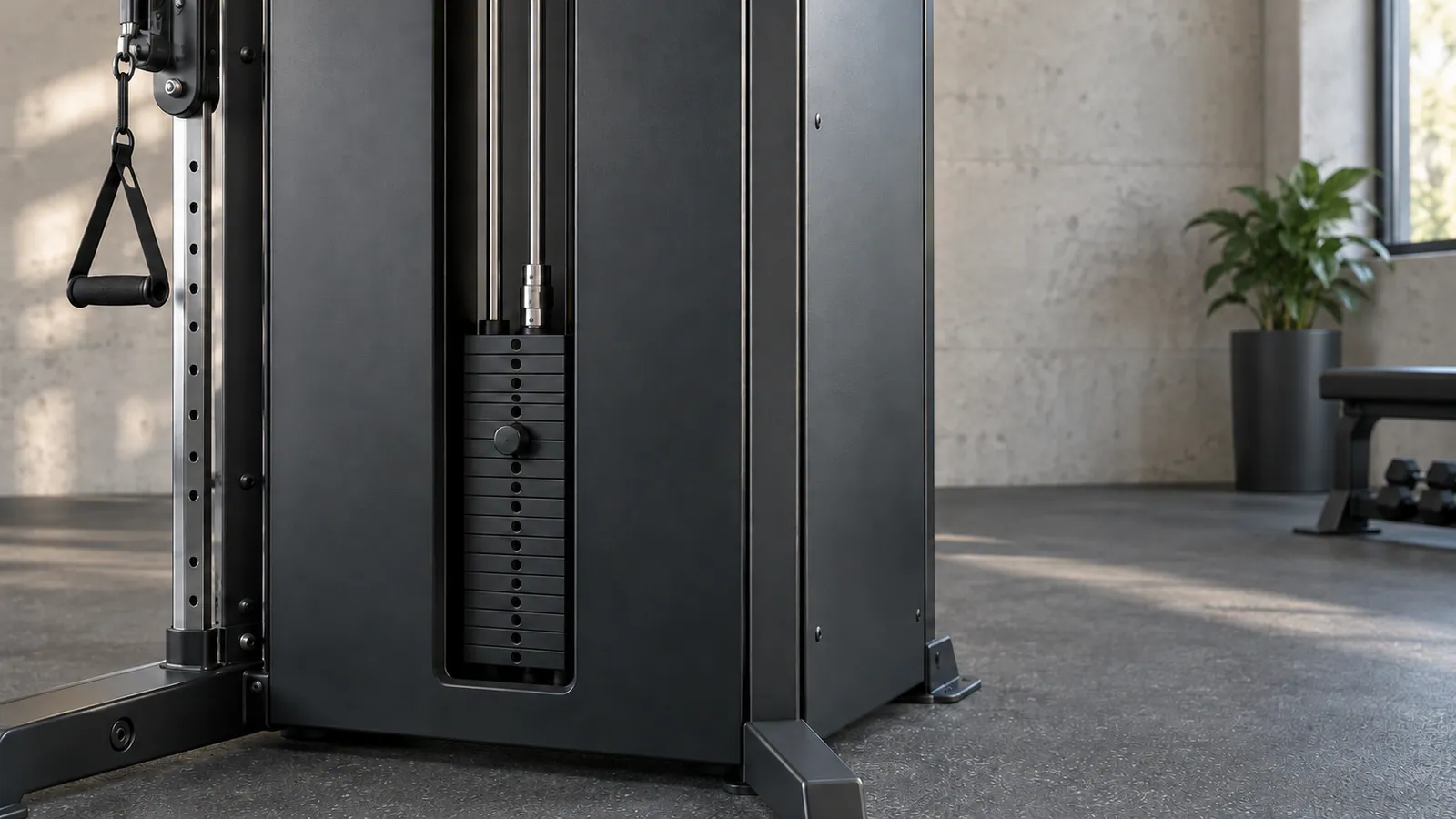
Put panel function on the order, not just the finish
A front photograph can make two cable stations look equally enclosed while hiding different rear arrangements. Before agreeing to a quotation, identify the tower, the supplied front and rear panels, and the opening used to select the weight. Ask which pieces are required guards and which are optional appearance panels. Record that distinction beside the configuration rather than assuming that a word such as shroud defines a complete protective boundary.
Manufacturer examples show why this question matters. Life Fitness lists rear-only and front-and-rear shroud choices for its Insignia series. REP offers model-specific Altitude attachment panels and does not guarantee fit with other brands. Those examples establish that cover arrangements differ; they do not establish what a PBF Fitness rack requires or whether a panel from either range can be fitted to it.
Check the installed boundary and the selector opening
At receiving, compare the assembled tower with the approved configuration from the supplier. Look at the rear as well as the side visible from the training position. Confirm that each specified panel is present and retained in its intended position. Do this with the machine stopped and out of use. A loose edge, missing fixing or damaged panel is a reason to pause acceptance and obtain a model-specific assessment.
The intended selector opening must remain usable without removing a required guard or reaching into the moving stack. The plates, guide system and cable path also need the clearances specified for that machine. Do not infer those clearances from the panel's thickness or a picture of another rack. Rubbing, deformation or an opening altered during installation needs correction before training, not an exercise session to see whether it improves.
Treat a missing guard as a service issue
The Cybex FT-360S owner manual explicitly prohibits use when guards are missing or damaged. That is a statement about its equipment, and a useful reminder to read the equivalent instructions for the rack being purchased. If your manufacturer's required guard is absent or damaged, isolate the affected station and request the matched part and its installation instructions. A cosmetically similar sheet is not evidence of an approved replacement.
Send the supplier the rack identification, ordered panel configuration, a stopped-machine overview and a close view of the affected area. Describe whether the panel is absent, loose, bent or contacting another component. Avoid drilling a new sheet, moving fixing points or restraining a panel with tape or cable ties. Those changes can alter retention, service access and the moving-component boundary without resolving the original defect.
Questions that settle acceptance
Does a rear panel mean the whole stack is enclosed? No: verify the complete arrangement and all intended openings. Can an optional cover replace a missing required guard? Only a manufacturer-approved configuration can establish that. Does a fitted enclosure make the station childproof? Do not make that claim. Covers do not replace supervision, keep-clear instructions or the equipment's inspection requirements.
For a purchasing decision, obtain three clear answers: what protective configuration is specified, how the user selects weight without defeating it, and how a damaged panel is replaced. Then compare those answers with the received assembly. This keeps a finish preference from becoming an unrecorded equipment change and gives the person maintaining the rack a concrete configuration to preserve.
- Compare multifunctional racks
- R05
- Rack Access Step or Exercise Platform? Confirm the Intended Use
- Ask about the rack configuration