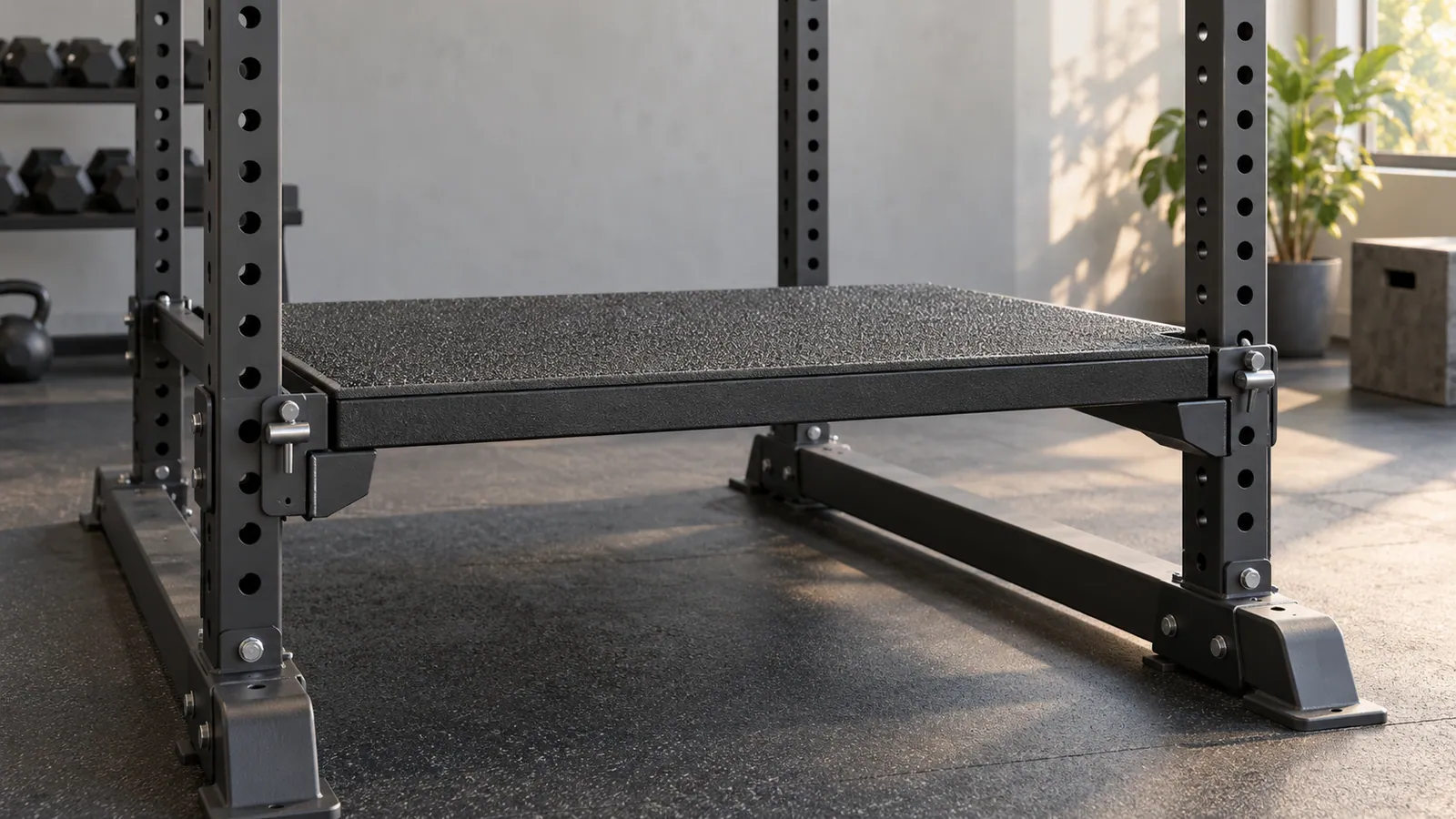
Start with the task: reaching or exercising
Write down what the standing surface will do before comparing accessories. Reaching a pull-up bar, getting onto a high attachment and performing repeated step-ups are different intended uses. A product called a step-up platform may still be described primarily as an access aid. Read the manufacturer's actual use statement, not only the product name or a photograph of someone standing on it.
Titan describes its TITAN Series rack-mounted step in the context of reaching pull-up bars and high attachments. Sveltus describes a marchepied for access on specified cage families. Those examples do not give permission to jump onto any rack step or add external weight. Ask the supplier whether the particular assembly is approved for your proposed exercise and what conditions accompany that use.
The platform, supports and rack form one assembly
List the platform, its supporting members, the retaining components and the rack installation together. A nominal hole pattern or upright section is not enough. The platform must seat on the intended supports, and its retention must prevent the movement addressed by the manufacturer's design. Do not substitute a board across bare safeties or use a row footplate or Smith leg-press attachment as an improvised standing surface.
Manufacturer arrangements are not interchangeable. REP describes supported exercise uses for its Utility Seat, with particular installation conditions for its spotter-arm configuration. Rogue specifies Monster Spotter Arms or Flip Down Safeties for its Monster Utility Seat and explicitly excludes standard rack crossmembers. A surface that works on one of those arrangements does not prove compatibility with a PBF Fitness rack. Request a matched configuration rather than combining instructions from different brands.
Allow room for the feet and the full movement
An accessory may fit between the uprights while leaving poor access for the user. Plan the standing area, the first step onto it, the route off it and the body movement around the frame. Consider overhead members, adjacent cable handles, benches and stored plates. Evaluate the actual intended use without inventing a universal platform height or treating the rack's overall footprint as the whole exercise envelope.
Ask for the installation instructions and all rack-stability conditions before accepting the arrangement. An example from another manufacturer may require floor fixing or approved extensions in a particular setup; it is not a universal instruction to anchor every rack in the same way. Do not use the frame, J-cup or safety load figure as a rating for a different platform assembly, and do not test an unapproved arrangement by standing on it.
Include changeover in the purchase decision
If the platform uses members otherwise needed for barbell catches, agree how the room will change between exercises. The platform must have a storage position that keeps routes clear. Before barbell training resumes, remove the accessory and restore the safeties to the position and configuration required for that exercise. A surface left installed can obstruct the catch area even when no one is using it.
Can one accessory serve both access and step-up training? Possibly, when the manufacturer explicitly approves both on the exact assembly. Can a padded seat or wide plate prove that approval? No. Send the intended movement, rack identification and proposed support arrangement to the supplier. A written answer covering use, retention and installation gives you a more useful basis for ordering than appearance alone.
- Compare multifunctional racks
- R05
- Weight-Stack Shrouds: Which Panels Must Be in Your Rack Order?
- Discuss the rack and platform arrangement