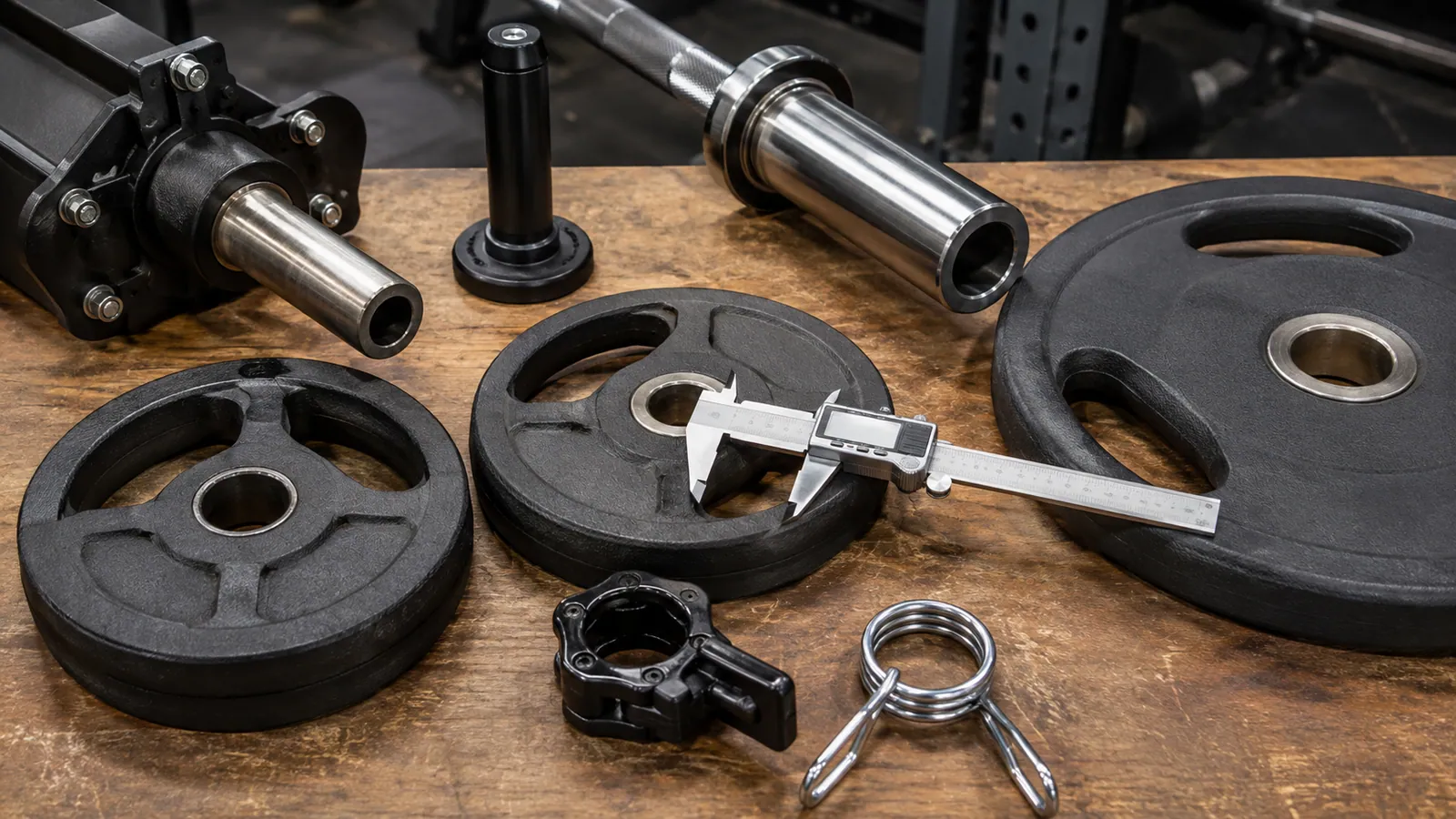
Map every place a plate must go
List the free bar, fixed Smith sleeves, plate-loaded cable trolley, landmine and each storage horn. They may not share one diameter or usable length. Record the manufacturer’s specified plate system for the exact configuration.
Measure only to diagnose or confirm documentation; do not grind a plate insert or machine sleeve. Coating, bushings and production tolerances mean a nominal label alone cannot prove fit.
Bore fit is only the first gate
A plate must slide on without force and leave room for the specified collar. Excess play is also relevant on moving carriages because the plate can rattle or shift; use the retaining method required by the manual.
Check sleeve shoulders, end stops and how much straight loading length remains after the collar. Plate thickness determines useful capacity more directly than the total kilograms you hope to add.
Outer diameter controls storage geometry
Large bumper plates can overlap an adjacent horn, hit the wall or block a low cable path even when their centre hole fits. Model the largest diameter on every peg and leave hand clearance to remove it.
Balance stored plates as the equipment instructions require. Storage is not a license to exceed a horn, frame or machine rating, and plate weight should not be treated as a substitute for prescribed anchoring.
Request one compatibility schedule
Send PBF Fitness the plate type, measured centre opening, largest outer diameter, thickness by denomination and photos of existing collars. Identify where each plate must be used or stored.
Approve the combination only when bore, sleeve, retention, loading length, movement clearance and storage access all work together. This prevents buying adapters that solve one interface while creating another problem.
- Compare multifunctional racks
- R05
- Can You Install a Smith Machine on a Sloped Garage Floor?
- Check your plate interfaces