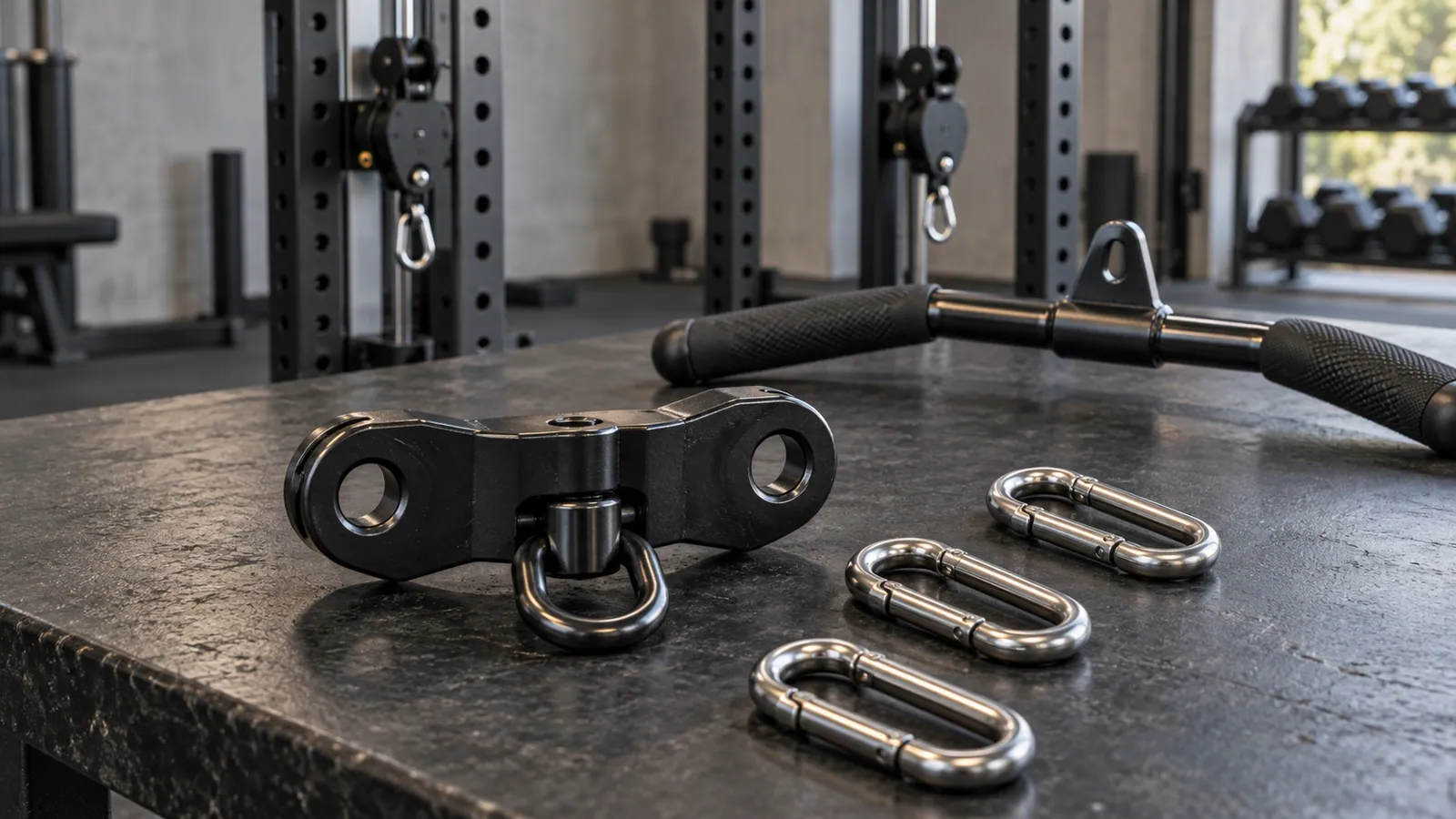
Start with the outlets, rather than the handle
A request for heavier pulldowns often begins with a wide bar and two cable ends. Identify where those ends originate first. A rack may have adjustable front trolleys as well as dedicated pulldown or row outlets. Their location, routing and intended movements can differ even when the clips look identical. A photograph of a similar rack cannot approve your proposed connection.
Give the supplier the model identification, revision and photographs showing both outlets in context. Ask which pair, if any, is intended to work through one attachment. An answer about having two stacks is incomplete. You need confirmation of the actual two-outlet configuration, its connector and the permitted exercise setup.
A two-to-one fitting is a specified assembly
REP’s current 2 to 1 Bar Connector page names ARES 2.0 compatibility. That bounded example shows why an accessory name is less useful than its declared application. A connection approved for that system does not establish fit on a PBF Fitness rack, an older revision or a pair of unrelated functional pulleys.
Confirm the connector part, both cable-side connections and the handle-side connection together. Obtain the applicable installation and use instructions, including any required alignment or retention. Do not substitute a chain, a general-purpose splitter or a longer clip arrangement to bridge an uncertain distance. Changing the assembled length also changes the starting position and available travel.
An older article or accessory photograph can remain online after a system changes. Match its revision to the current parts information. If the connector listing and the machine instructions appear to disagree, ask the manufacturer to resolve the exact combination before buying or using it.
Check movement and resistance separately
After approval, follow the manufacturer’s procedure for connecting and checking the assembly. Confirm that the handle, fitting and cable terminals can move through the prescribed range without twisting, contacting the rack or reaching an end stop early. A smooth initial pull cannot establish the full range. An unexplained mismatch between the sides is a reason to stop and seek guidance.
The number on a stack is not necessarily the resistance at the hand. Routing, ratios and the approved combined configuration matter. Ask for the manufacturer’s resistance description at the selected outlet pair; do not calculate a new training limit by summing the labels. Neither a connector nor an empty-range check increases a machine’s permitted load.
Questions to settle before ordering
Can both front trolley cables always be joined? No. Adjustable outlets that work independently are not automatically an approved pair for a shared handle. Use the model’s specified configuration; if no shared-handle arrangement is documented, keep the intended independent use.
Will any three-hole connector work? Hole count is insufficient. The exact fitting, connection geometry, retention and declared application must be confirmed. For a rack enquiry, send the model and outlet photographs to PBF Fitness with your intended pulldown or row movement. Ask which configuration can be supported and which parts are supplied; the R05 product page is a starting point for discussion, not proof of connector compatibility.
- Compare multifunctional racks
- R05
- Rack J-Cups: Match the Pair and Check Full Seating
- Check my cable connection configuration