Read the whole guide system
A Smith carriage is not judged by the bearing name alone.
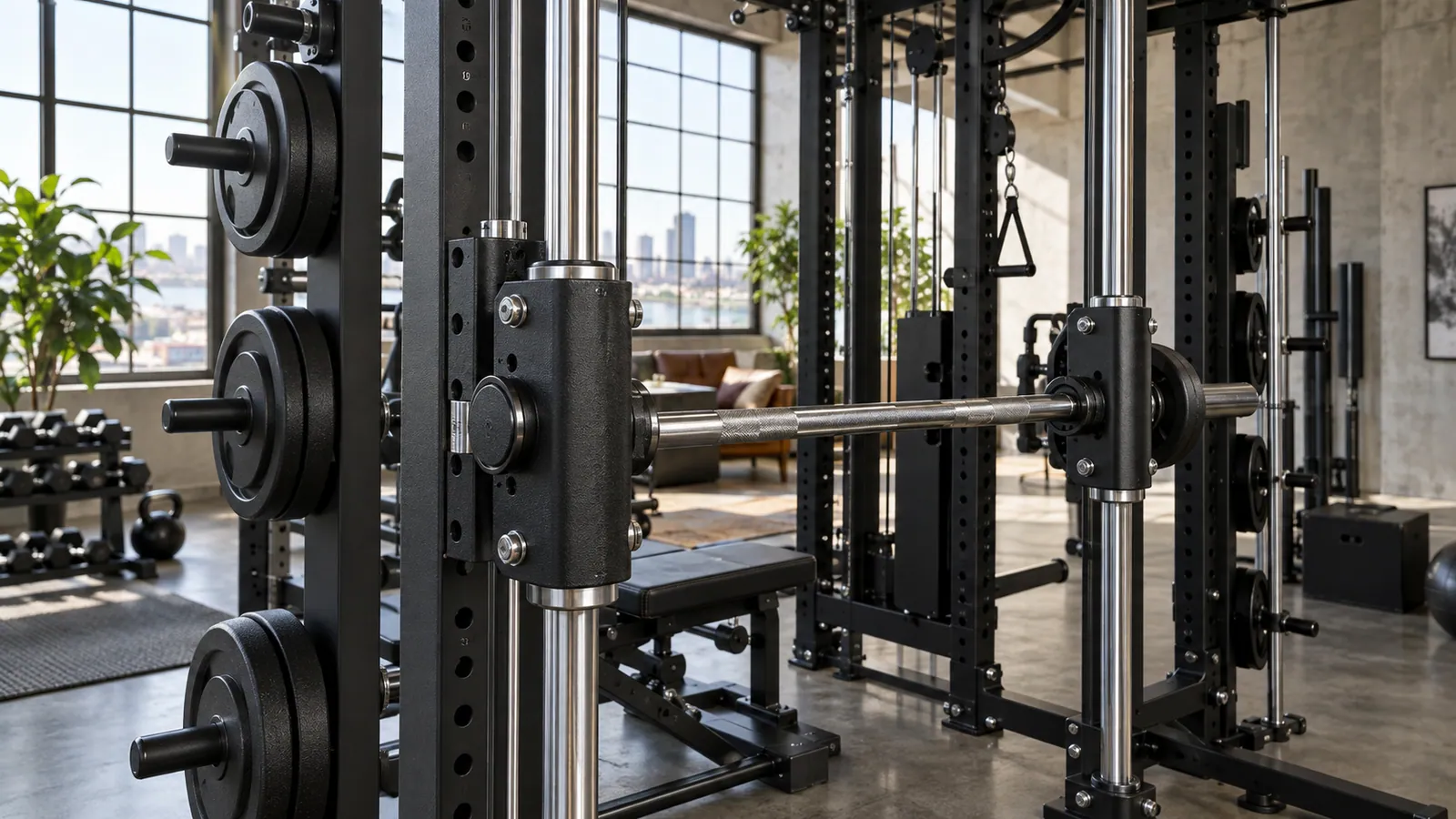
Guide-rod diameter and finish, bearing fit, carriage stiffness and the distance between supports all affect whether the bar starts and travels evenly.
Linear ball bearings use rolling elements around a shaft.
Test travel instead of marketing words
A bushing slides on its mating surface, while some Smith designs guide the carriage with rollers. Each architecture needs the correct rail, tolerance and protection from dirt.
Move the unloaded bar from its lowest usable point to the top, then repeat with equal plates on both sides. Check starting force, pauses, noise and left-right hesitation without deliberately twisting the bar.
A showroom glide can hide poor alignment, and a dry mechanism can hide behind heavy counterbalance. Ask how the system behaves after transport, assembly and realistic loading, and which adjustment procedure is documented.
Plan alignment and service
Guide rods must remain parallel and concentric with their bearings. Uneven floor support, forced assembly or loose crossmembers can introduce binding; installation should follow the exact sequence and torque guidance for that model.
Confirm whether bearings are sealed or serviceable, which cleaner or lubricant is permitted, and how a worn carriage part is replaced. Choose the system with repeatable full-stroke motion and available service parts. Send the room, model and expected loading for a configuration review.
- Compare multifunctional racks
- R05
- Aluminum vs Nylon Pulleys on a Functional Trainer Rack: Which Is Better?
- Check rack depth for your room