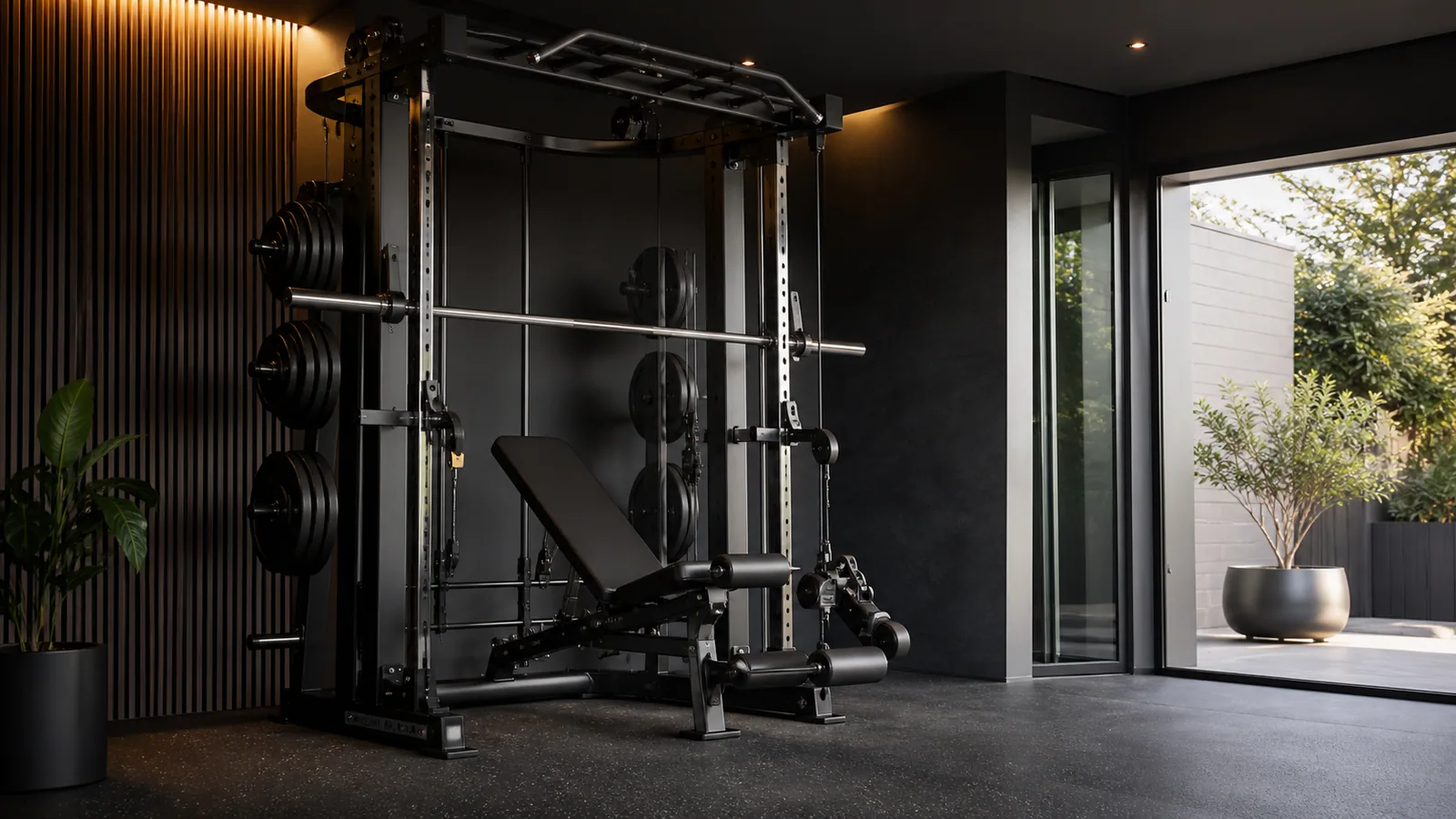
A Smith bar and carriage have physical mass, but bearings, rail angle and a counterbalance can change how much force the user must apply. That is why credible product documents may report very different starting resistances and why one universal ‘Smith bar weight’ is misleading.
| Term | What it describes | How to use it |
|---|---|---|
| Physical moving mass | Bar, carriage and attached moving parts | Engineering and service context |
| Counterbalance | Force that offsets part of the moving mass | Explains why the bar can feel lighter |
| Starting resistance | Force needed at the stated test position | Training log and model comparison |
Do not treat bar mass and starting resistance as synonyms
The bar, sleeves, hooks and carriage move together, while a cable or weight system may offset some of that mass. Friction and guide geometry add further effects. The number a user feels at the start is therefore a system result, not a scale reading of one component.
‘Olympic sleeves’ usually describes plate compatibility. It does not tell a buyer the empty starting load.
Understand why the value changes between models
Guide-rail angle, bearing or bushing design, counterweight travel, cable routing, lubrication and alignment all influence resistance. Two all-in-one trainers can look similar in a catalog yet start differently.
Maintenance matters too. A machine that binds or pulls unevenly should be inspected, not assigned a new informal bar-weight estimate.
Request a specification that can be checked
Ask the supplier to state the starting resistance, measurement method, bar position and tested configuration in writing for the exact model code. Confirm whether every moving attachment is included in that value.
Use the same document to check travel, safety stops, hook positions, sleeve diameter and published capacity. Never copy a value from another brand or a visually similar revision.
Apply the number consistently in training
For a training log, add the plates loaded to the documented starting resistance and compare progress on the same machine. Do not assume the total transfers one-to-one to a free barbell or another Smith system.
For beginners, rehabilitation or low-load work, the minimum usable resistance and controlled range may matter more than the maximum plate capacity. Programming still needs appropriate coaching or clinical advice.
Verify the delivered machine before loading
Move the unloaded carriage through its full permitted travel. Check that both sides run evenly and that hooks, stops and limiters engage as designed. Resolve misalignment, damage or binding before adding plates.
For a PBF Fitness configuration, send the exact model code and options. We will confirm documented data when available rather than substitute an estimate.