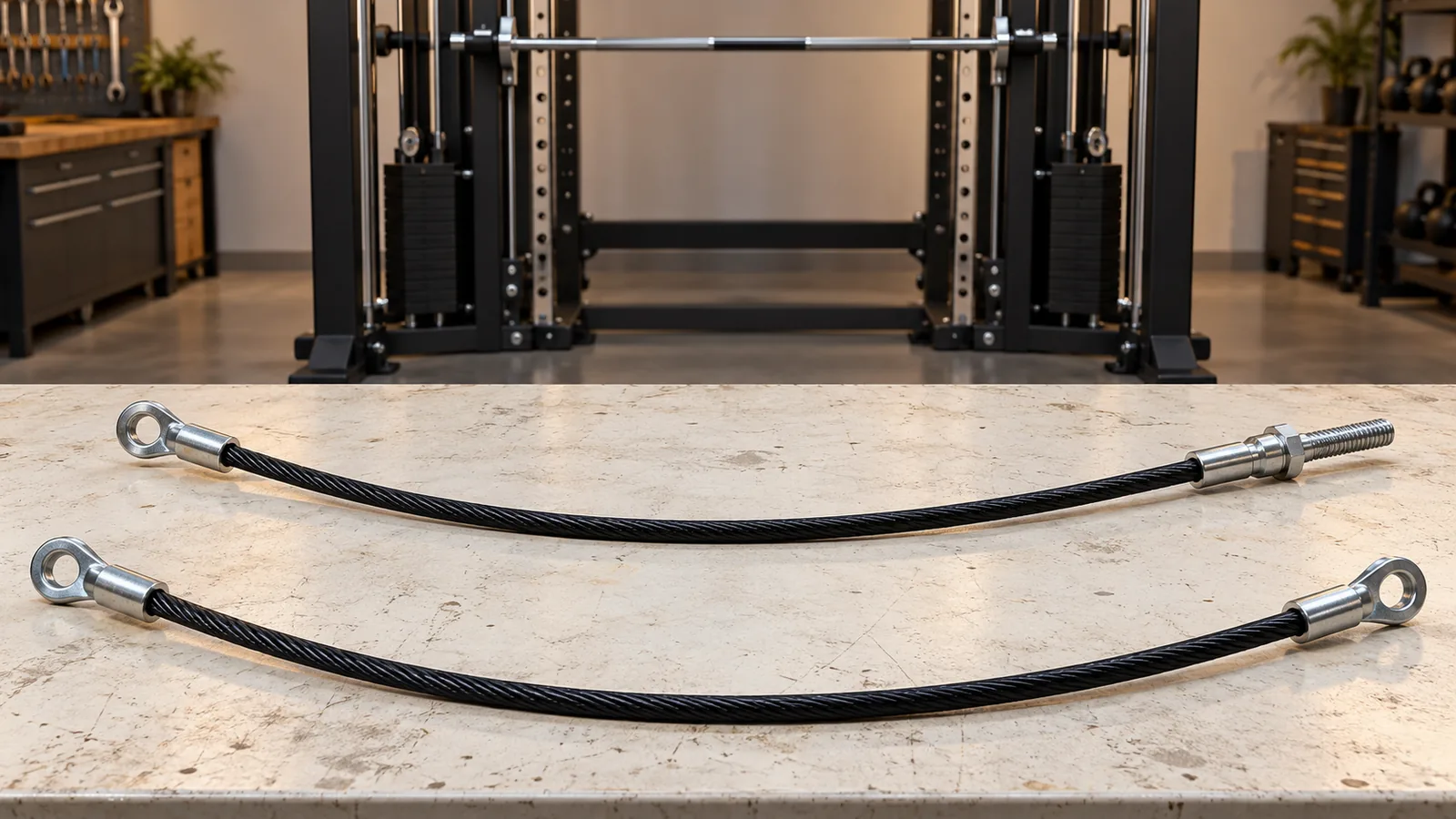
One all-in-one rack can contain different cable systems
A rack can combine a cable station with a Smith mechanism, but that does not mean every cable has the same role. The cable attached to a handle outlet and a cable connected to a bar-counterweight assembly follow different component chains. The visible coating or an apparently similar diameter cannot identify the correct spare.
The Life Fitness Signature Smith drawing distinguishes the lift bar, carriages, rod ends and counterweight cables. The HOIST CF-3753 documentation likewise lists a specific counterweight and cable assembly. These examples establish separate systems on those models, not the cable layout or parts supplied on a PBF Fitness machine.
Name the part without opening the protected mechanism
Collect the model and serial information, manual revision and an external photograph of the area concerned. Use the parts drawing to identify the suspected circuit and callout. Ask the supplier to confirm that identification rather than selecting a cable solely from its length or a photograph of its end fitting.
Describe what was observed during ordinary permitted use: a changed sound, unexpected contact or a visible damaged section. Do not keep cycling the bar to reproduce a doubtful fault for a video. If a view would require guard removal or entering the counterweight path, leave that inspection to the prescribed service process.
The HOIST manual’s counterweight handling warning shows why ordinary hardware removal can have consequences beyond the fastener itself. It is not a reason to copy its support or disassembly steps to another model. A shipping restraint, a service cover and a working bar lock must each be identified in their own instructions.
Order the complete approved service item
Have the manufacturer confirm the exact cable reference, end fittings, associated retaining parts and the scope of the repair. Ask whether the required parts are supplied as an assembly and whether a change in revision affects the replacement. A functional-trainer cable should not be substituted because it happens to reach the connection.
Do not shorten, splice or recrimp a cable to make an uncertain part fit. Do not add weight to the counterbalance or disconnect it to alter the bar’s feel. The question here is restoring the specified system, not calculating a new starting resistance or converting the rack to another architecture.
Can I attach a training handle to a counterweight cable?
Use only an outlet and connection approved for exercise on the actual equipment. A cable in the bar-counterbalance circuit is not an extra training outlet.
Is an exercise cable of the same length a suitable spare?
Length alone does not confirm cable identity, end fittings, retention or revision. Obtain the manufacturer’s matched service reference and repair requirements.
A smooth-moving bar is only one part of handover
Counterbalance, bar hooks and independent safety devices have different functions. A counterweight is not a substitute for correctly used bar locks or safeties. The repair record should identify which system was serviced and what remains to be checked under the machine’s instructions.
Arrange a qualified provider to follow the applicable service procedure and complete the manufacturer’s acceptance checks before release. Keep the final parts references and revision with the machine. Avoid a self-designed loaded test or a claim that one smooth cycle proves every cable, stop and guard is correct.
For a PBF Fitness enquiry, send the actual rack model, Smith-system reference, manual and external fault information. Ask for model-specific service documentation and a matched parts review. Do not use another maker’s cable specification or counterweight value as the order specification for your rack.
- Compare multifunctional racks
- R05
- Rack Weight-Stack Bumpers: Keep the Specified Support
- Review a Smith-system service reference