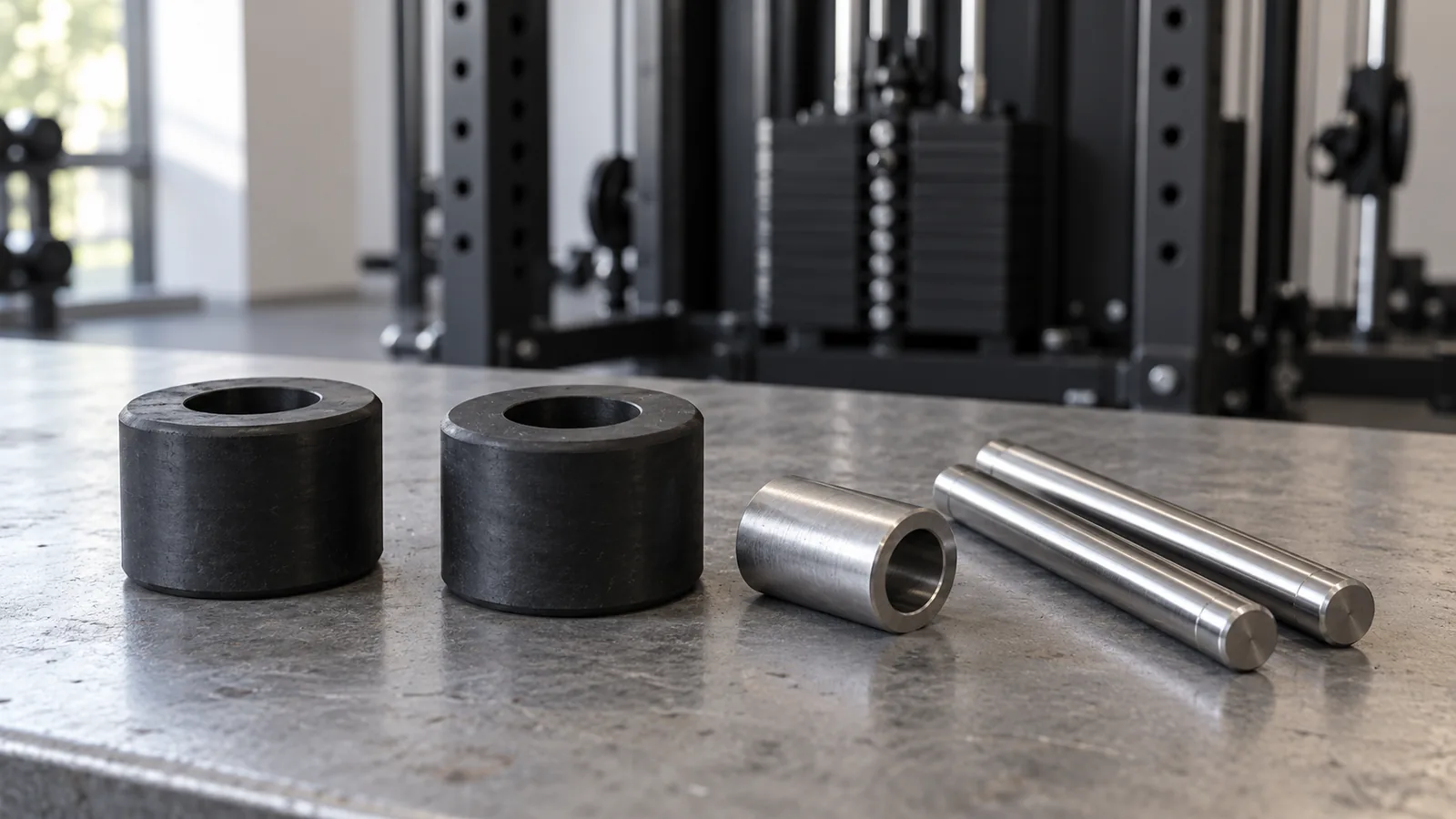
Locate the bumper in the correct assembly drawing
The word bumper can refer to several parts on one machine: a stack support, a carriage stop, a Smith-bar stop pad or a plate-storage ring. Start with the exact parts drawing and callout. A round black item in a photograph does not establish its function, material or required dimensions.
Rogue’s FM-HR Independent instructions show weight-stack bumpers positioned at designated guide-rod holes on a weight-stack spacer. That is a useful example of a defined lower assembly. It does not establish the bumper set, spacer height or fitting method for another cable rack. Use the drawing and revision that match the installed equipment.
A replacement request needs more than a hole diameter
Send the model and serial reference, cable-system version, drawing callout and photographs taken from the permitted inspection area. Ask whether the quoted service part is supplied singly, in a set or with associated hardware. Record the quantity and approved placement rather than copying the count from a different machine.
The required assembly can include bumpers, a spacer and guide rods that locate the stack. A physically similar ring may differ in its intended support or fitted height. Do not build a substitute from hardware-store washers, cut an unknown rubber pad or mix parts left over from another rack.
If an upgrade changes the stack arrangement, obtain the complete approved configuration. An existing bumper that fits a guide rod is not proof that it belongs under the revised stack. Keep the upgrade instructions and replacement-part record together so the next service request identifies what is actually installed.
Observe from outside the moving area
Follow the machine’s inspection instructions with the station unavailable for use. Look only from the access positions permitted by its manual. Do not lift the stack to put fingers underneath, reach between plates or release guide rods to inspect a part. A service operation involving the stack needs the prescribed support and qualified handling.
Report the observed condition without inventing a diagnosis: a visible missing piece, cracking, displaced material or an unfamiliar contact noise. These observations do not tell you which replacement will fit. Leave the station isolated when condition or support is uncertain and have the manufacturer define the remedy.
Can I use a rubber ring with the same centre hole?
A matching hole alone does not establish the required support, fitted height or part identity. Request the specified replacement for the actual assembly.
Can I remove the bumper for more cable travel?
Keep the manufacturer’s specified assembly unless it approves a different complete configuration. Do not alter the stack support as a travel adjustment.
Keep the original support and the service handover
Removing a bumper or spacer changes the specified lower assembly. Do not treat that as a way to add cable travel or change the resting plate position. A cable adjustment cannot be assumed to compensate for a missing support. These are separate parts of the machine’s approved configuration.
Ask the service provider to identify the replacement parts, restore the specified assembly and complete the manufacturer’s return-to-service checks. Record the final drawing revision and what was replaced. Do not devise a proof test by dropping the stack or adding more load.
For a PBF Fitness project, provide the rack model, cable-system reference, parts drawing and external photographs. Ask for the documents and service parts matching the actual order. A general rack catalogue or another brand’s assembly diagram does not confirm the bumpers supplied for your equipment.
- Compare multifunctional racks
- R05
- Smith Counterweight Cables: Identify the System Before Ordering Parts
- Review cable-stack parts for my rack