Three lengths answer three different questions
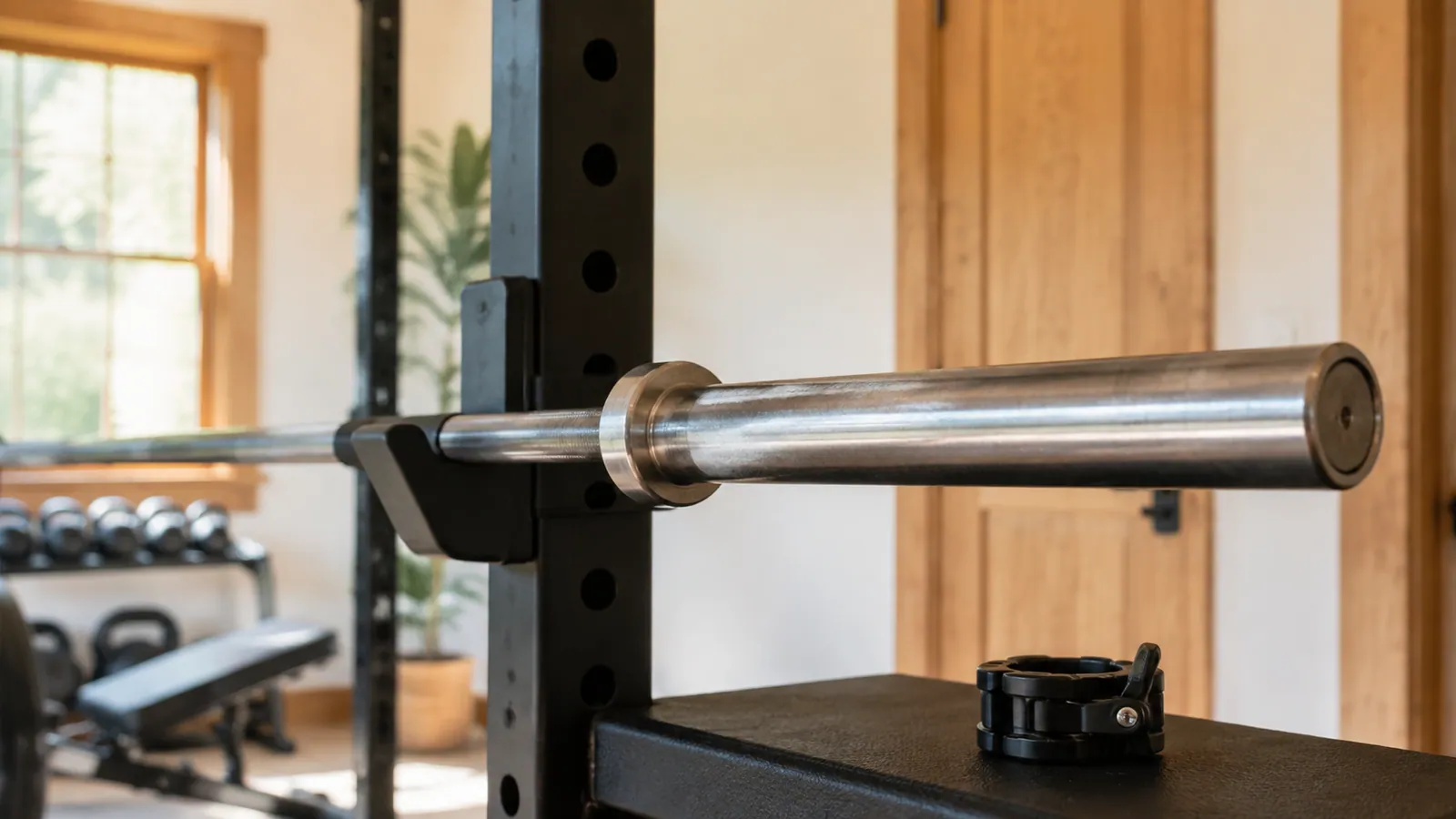
Total bar length describes how much side-to-side room the bar occupies. The distance between the inner sleeve shoulders determines whether the central shaft can span the rack supports. Loadable sleeve length determines how much space remains for plates and the required collars.
Short bars do not all achieve their smaller size in the same way. Some shorten the sleeves while retaining a long central shaft; others shorten the shaft itself. Manufacturer descriptions of rackable and non-rackable short bars demonstrate why a single overall-length label is not a compatibility specification.
| Dimension | Decision it supports |
|---|---|
| Overall length | Room width, handling and storage |
| Inner shoulder-to-shoulder span | Correct seating on both rack supports |
| Usable sleeve length | Plate thickness plus collar engagement |
Measure the installed J-cups, not only the space between uprights
The clear opening inside the rack is not the complete support span. Upright thickness, the chosen J-cups and their lateral contact surfaces matter. Measure the actual configuration and ask the supplier where the bar shaft is intended to contact the supports.
Each inner sleeve shoulder must remain outside the relevant support contact area. A bar that just balances at the edge is not an acceptable solution. Obtain the manufacturer's required clearance; do not turn a zero-margin tape measurement into an approval.
Changing to independent squat stands is a separate equipment decision with its own stability and setup requirements. Do not narrow a fixed rack, reverse its J-cups or support the bar on its rotating sleeves to make a short bar appear to fit.
The space saved at the ends has a loading cost
Lay out the actual plates you plan to use and add their thickness on each side. Include enough sleeve for the specified collar to engage fully. Thick bumper plates can consume the available space before the intended training load is reached; thinner plates do not increase the bar's rated capacity.
A sleeve diameter compatible with your plates answers only the plate-fit question. It says nothing about the rack span, usable loading length or exercise suitability. Likewise, a lighter bar is not automatically short, and a short bar is not automatically appropriate for every grip or movement.
Keep side access for hands and plates after locating the bar in the room. Saving overall length can improve a narrow setup, but a sleeve pressed against a wall still cannot be loaded conveniently. Include storage horns, door movement and nearby equipment in this clearance check.
Approve a bar-and-rack pair, not a description
Before buying, collect the bar's dimensional drawing, permitted use and load rating, plus the exact rack and J-cup references. Confirm the measured support span and loading plan with the suppliers. On delivery, inspect the unloaded pair and follow the equipment instructions before training.
When discussing a PBF Fitness power rack, send the intended free-bar drawing and your plate-and-collar combination. Ask for the support dimensions of the proposed rack configuration. This lets you preserve useful floor space without assuming that the rack manufacturer supplies, endorses or guarantees every compact bar on the market.
- Compare cable trainer configurations
- R04
- Will Your Adjustable Bench Fit a Smith Machine or Power Rack?
- Discuss the loading system