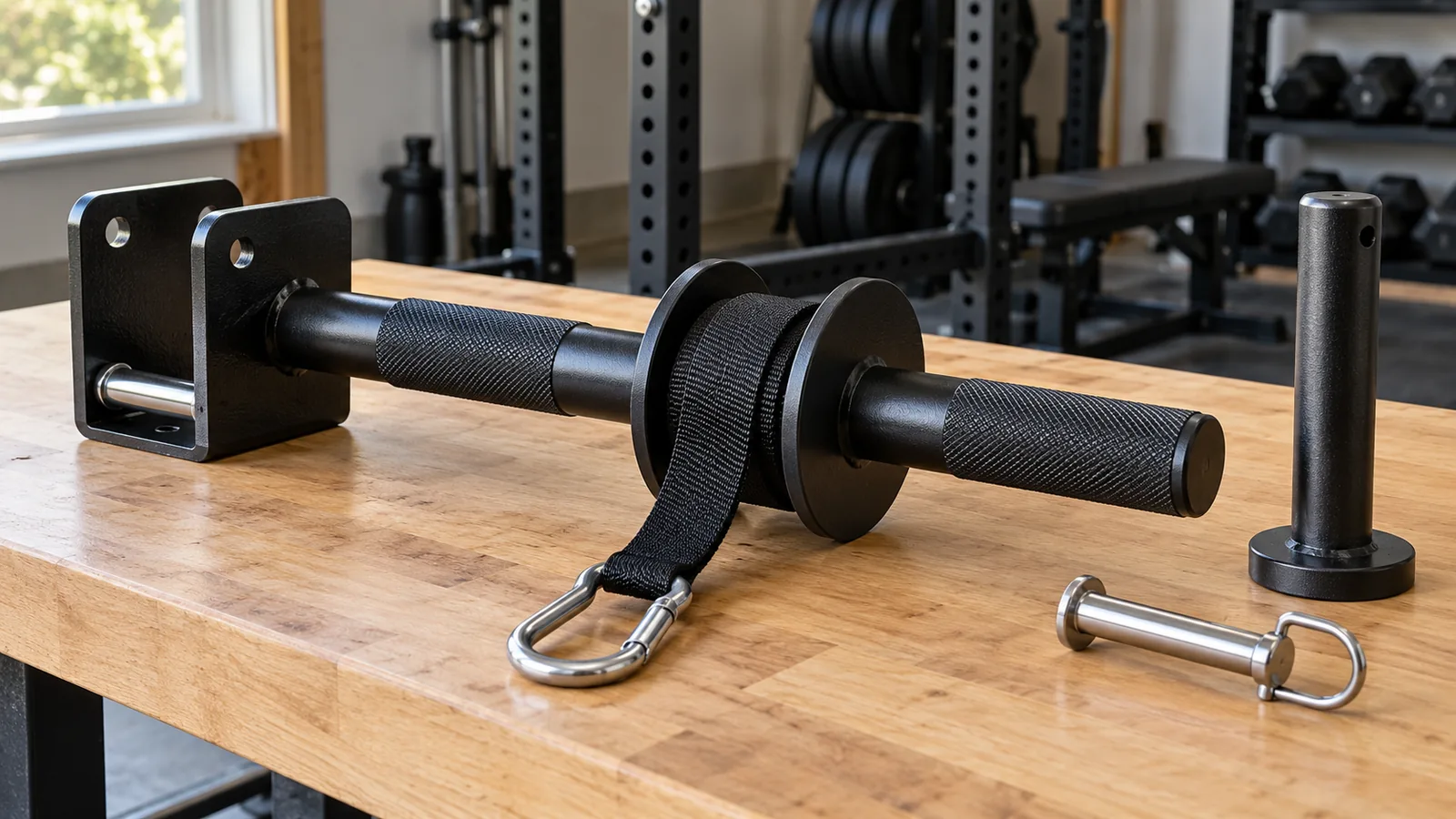
Separate the fixed support from the rotating roller
A rack-mounted wrist roller transfers support to a specific bracket while the hand-grip axle turns and winds a strap. Those are separate jobs. The installed bracket should remain seated under its instructions; rotation of the roller is not permission for the support or retaining parts to work loose.
Sorinex illustrates the roller, central strap and rack fixing as one assembly. Use such an illustration to understand the parts, then obtain the drawing for your exact product. Do not convert a spare rack pin, a barbell sleeve or an unrelated foam roller into an axle support because the dimensions appear close.
Ask which rack face and retention the mount requires
State the rack series and revision, mounting face and intended installation position. Have the supplier identify every bracket, liner, pin, knob or fastener that belongs to the assembly. The nominal size of an upright does not confirm the spacing, stand-off or retention of a different manufacturer's accessory.
Titan's wrist roller names particular rack families and a particular upright interface. That example is useful precisely because it is specific. Confirm your own combination rather than transferring its compatibility statement, loading choices or published capacity to a PBF rack or another roller.
Treat the strap and load connection as part of the product
The free end may connect to a specified plate arrangement, loading pin or other approved load. Obtain the actual method for the supplied model, including what comes in the order. A photographed weight or a carabiner that closes is not proof that an improvised connection will retain that load during use.
Keep the supplied strap specification with the accessory record. Its attachment, length and permitted load connection belong to that assembly; do not treat a similar-looking strap as an interchangeable replacement. Inspect the strap and connectors under the maker's criteria, isolate a frayed strap, damaged end or doubtful connection and request the matched part instead of tying a knot or adding an extension.
Draw the whole lift and lower path
Show the roller height, the supplied strap arrangement and the dimensions of the permitted suspended load. Check the space beneath and around it through the allowed travel, including the rack base, stored equipment and the user's feet. Keep other people and objects out of that operating zone; a small accessory can still need a dedicated floor area.
Allow room for hands to turn the actual grip without striking the bracket or upright. Assess fit without a suspended training load using the instructions, and have the intended user consider access and hand position. Do not prescribe one mounting height, load or training volume for every user, and do not route the roller strap through the rack's cable system to gain travel.
Can a handheld wrist roller simply rest on a bar in the rack?
Use only a supported configuration expressly provided by the roller and rack makers. A handheld product does not become a rack accessory merely because it can be balanced on another part.
Can I add a longer strap to increase travel?
Do not change the strap specification or route without approval for that exact assembly. Request the matched replacement and confirm the permitted travel and load connection.
Plan the changeover before making it permanent
Before removing or repositioning the assembly, put the load into the supported condition specified by its maker. Store the strap and connectors as instructed so they do not enter a cable trolley, barbell bay or walking route. Do not leave a loaded roller suspended as an informal storage station.
For a quotation, send the rack reference, mounting face, desired position, load type and measured floor space. Ask for the complete accessory list, installation method and replacement strap reference. That gives the supplier a concrete setup to approve and lets you compare a fixed rack version with a separate handheld product without treating them as interchangeable.
- Compare multifunctional racks
- R05
- A Heavy Bag on Your Rack: Approve the Hanger and Its Swing Space
- Check a wrist-roller station for my rack