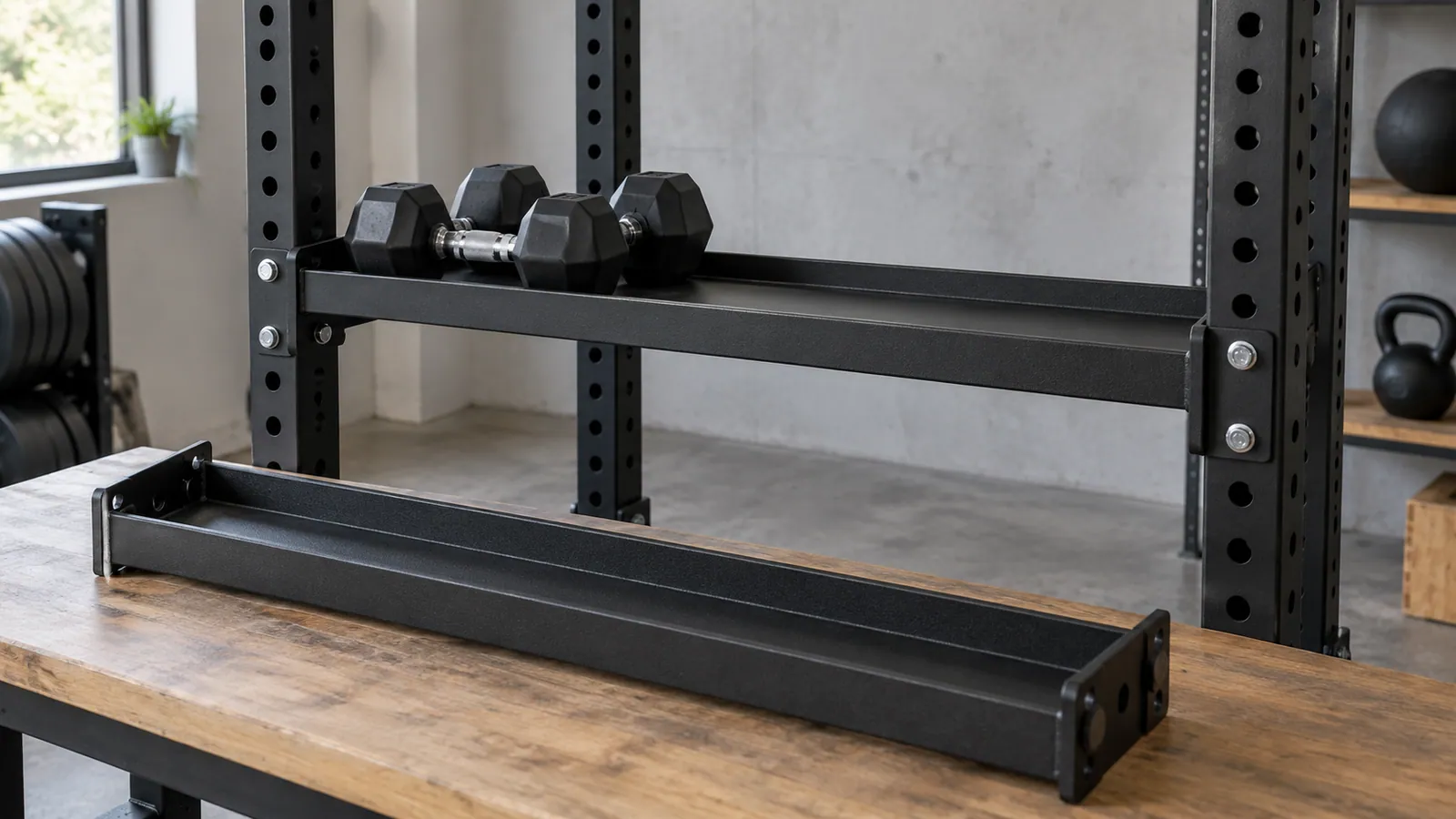
Order the load path, rather than just the tray
A shelf photograph can hide the parts carrying its load. Ask whether the tray mounts directly to uprights, rests on rails, or requires a separate support member. The quotation should identify the complete assembly and the exact rack series, span and revision. Matching hole diameter alone does not settle that question.
Rogue’s Monster Storage kettlebell-shelf instructions illustrate a tray that requires a specified parallel shelf beneath it. Its single-post storage product is a separate system. Keep those assemblies distinct when discussing parts; a similar brand name is not permission to exchange supports or fastening methods.
In a rack used for both cable work and free-bar sessions, plan storage around the configuration you use most often. A shelf that must be emptied or removed at every changeover may save floor space while adding handling. Compare that routine with a separate storage unit before choosing the rack-mounted option.
Measure the weights you actually own
Record the overall head width, depth and handle position of each dumbbell type. Adjustable dumbbells need their actual base or cradle considered as well. A nominal weight tells you little about the space the item occupies. Check the largest equipment and the awkward small pair rather than assuming the whole range behaves alike.
Shelf orientation and edge placement affect access and retention. REP’s current shelf information distinguishes its intended dumbbell and kettlebell arrangements. Follow the exact shelf’s instructions; turning another tray around does not automatically make it suitable for both. Do not rely on an angled surface to secure round weights without the maker’s specified arrangement.
Allow room to grip the handle, lift the weight clear of the edge and return it without squeezing fingers beneath the next shelf. Equipment that fits at rest may still be difficult to retrieve. Use measurements or an approved demonstration to assess this motion; do not test an uncertain installation by loading it.
Keep storage outside the station’s movement
Map the shelf and the stored weights together against the free bar, Smith sleeves, cable handles and moving attachments. Include the pickup path, rather than checking only whether the bare tray clears the frame. A shelf inside the lifting bay can consume space needed for a different exercise.
Confirm the shelf’s own loading limit and permitted distribution in the approved configuration. A rack-frame rating is not a tray rating. Storage does not establish a new bracing function, and a convenient flat surface does not make a step. If capacity figures or model exclusions disagree, obtain a written answer before ordering.
What to send with a shelf enquiry
Can one shelf store every dumbbell and kettlebell? Only if its maker approves those equipment types and the actual fit and handling space work. A tray intended for kettlebells need not hold dumbbells securely. Ask for the suitable shelf style instead of improvising stops or drilling new holes.
Send PBF Fitness the rack identification, intended mounting position, photographs or dimensions of your weights and the movements that must remain available. Request the complete approved storage option and its instructions. The R05 catalogue page can begin a rack discussion; it does not confirm that a shelf kit is supplied or compatible.
- Compare multifunctional racks
- R05
- Squat Stand Wheel Kits: Move Only the Approved, Unloaded Setup
- Review my rack storage configuration