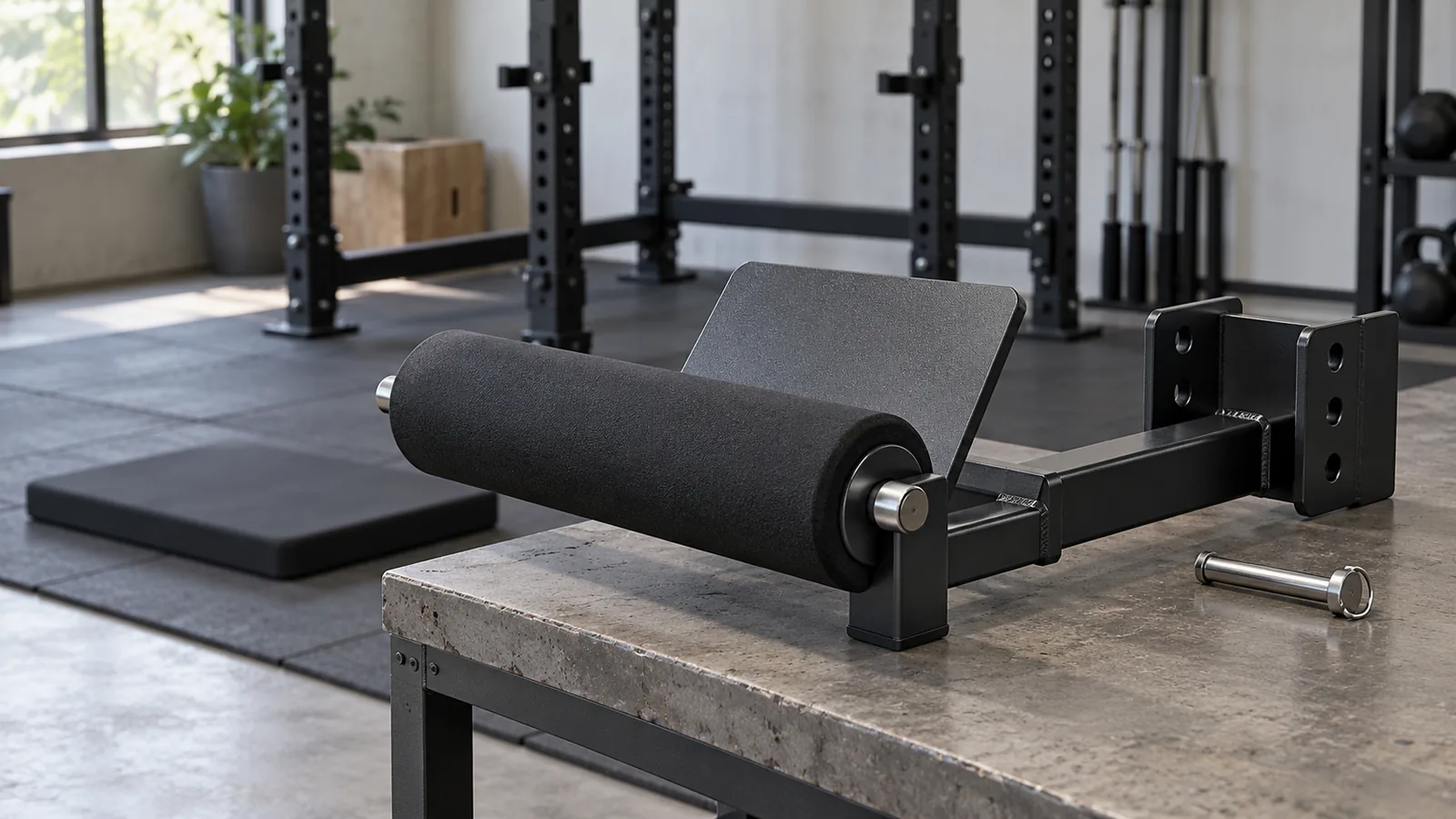
Start with the restraint, not the exercise name
A Nordic curl station holds the lower legs while the user kneels in front of the support. That job differs from supporting a rear foot in a split squat or holding the thighs during a pulldown. Ask the rack maker to confirm the intended exercise and the entire installed configuration before treating an existing pad as a substitute.
A dedicated foot plate and an ankle roller also perform different tasks. Stray Dog Strength lists a Nordic attachment with a foot plate, selected mounting variants and a threaded retaining pin. That example shows why a photograph of the foam surface is insufficient for ordering; it does not establish cross-brand fit or a PBF specification.
Match the complete rack connection
Identify the rack series, revision, mounting face and accessory reference. The bracket must seat as the drawing requires, with the specified pin, knob or fasteners fully engaged. A connection that appears to fit one upright can still have the wrong stand-off, retention or approved loading direction. Do not enlarge holes, pack gaps or substitute a storage pin.
Even one manufacturer can use different solutions over time. The older Hammer Strength HD Elite assembly sheet shows a Nordic module with paired structural plates, whereas the iD range describes a modular accessory with its own Lock Knob. Use the instructions belonging to the exact installed version, rather than combining parts that share an exercise name.
Assess the knees and ankles as one layout
Confirm where the lower leg contacts the pad, whether the foot plate is part of the approved setup and how the kneeling surface sits relative to that contact. A thicker loose pad changes the relationship even if the rack attachment stays in the same hole. Record the actual floor and pad arrangement instead of copying a nominal roller height from another gym.
A fit check is not a forced repetition or a test of maximum holding strength. Arrange the station under its instructions and have the intended user assess entry, lower-leg contact and exit without added training load. Stop when contact is painful, the restraint cannot be released in control or the mount moves unexpectedly; obtain appropriate setup guidance before continuing.
Can a lat-pulldown thigh pad hold the ankles instead?
Only if the manufacturer explicitly approves that exact installed assembly for Nordic curls. Similar upholstery or a convenient height does not establish the intended contact, retention or loading direction.
Does adding a band make an uncertain anchor acceptable?
No. Assistance does not establish rack compatibility. Any assisted configuration needs its own approved anchoring, routing and setup guidance; this buying check does not prescribe a training progression.
Reserve the space the person will use
The attachment may be compact while the working area extends well beyond the rack. Plan a clear surface in front of the knees for the body and hands, a way to approach and leave the restraint, and separation from stored plates, a bench and moving cable parts. Do not run another station through that area while it is occupied.
Send PBF Fitness the rack identity, accessory drawing, intended mounting side and a side view showing the kneeling surface and available floor. Ask whether an approved complete station is available for that rack. If the answer requires a different assembly or floor layout, resolve that before ordering a roller on its own.
- Compare multifunctional racks
- R05
- Rack Wall-Ball Targets: Check the Mount, Height Datum and Return Space
- Discuss a complete Nordic station for my rack