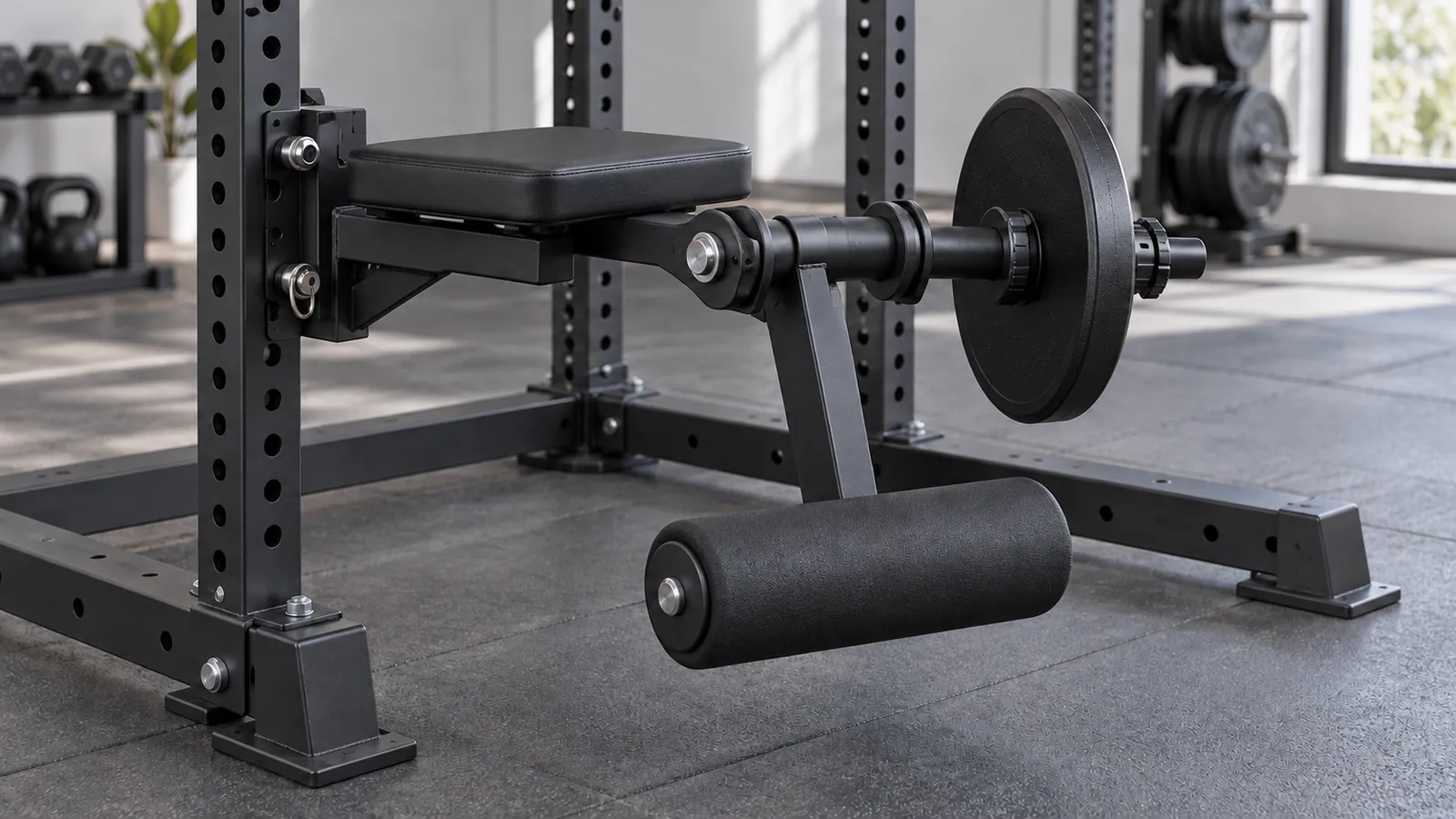
Specify the movement before comparing the attachment
A photograph of two foam rollers does not reveal whether the device is a fixed brace or a loaded leg developer. A brace holds part of the body in place; a developer has a moving resistance arrangement for a stated exercise. Ask whether the offered unit provides seated leg extensions, standing curls, seated curls or prone curls, and what components are needed for each approved configuration.
Titan describes seated extensions and standing curls for its TITAN Series module. Bulletproof’s Isolator uses a configurable seat, lever and pad system. These are examples of different architectures, not a reason to mix their parts or assume that every rack accessory offers the same movements. Put the required exercise and complete accessory package on the quotation rather than relying on a broad claim that it trains legs.
Keep rack compatibility and body adjustment separate
Confirm the rack model and revision, the actual upright interface and the complete retaining arrangement. A bracket that slips over an upright is not evidence that the module is approved for that rack’s installed configuration. Titan’s page expressly distinguishes its metric interface from other nominally similar uprights. Ask for matched drawings and installation requirements instead of transferring a nominal 3-inch label to a different frame.
Then review the intended users with the supplier. Seat height and depth, the relation between the knee and the module’s pivot, and the position of the contact roller need to work together. More adjustment holes do not guarantee that the short or tall user can obtain the intended supported position. Request the relevant adjustment range and a demonstration of the approved setup for your user sizes.
Compare pad positioning through the intended movement, not only in a posed start photograph. A pad that slides into an uncomfortable location or a seat that makes the user reach for support is a fit issue to resolve. Do not force the body into a fixed geometry by adding loose cushions or relocating mounting holes. Equipment adjustability also does not establish medical suitability or a rehabilitation benefit.
Reserve space for the lever, plates and changeover
The attachment may occupy little space when parked while its loading arm swings into a much larger area. Include the complete plate diameter, retainer, user’s legs and route onto and off the seat. Check the adjacent bench, cable station, barbell catch area and stored plates against the approved movement envelope. Do not treat the accessory’s static dimensions as the entire working footprint.
Agree how adjustments and removal are performed with resistance returned to the specified rest and plates removed when the instructions require it. Identify a storage position and handling method for the complete module, including heavy or awkward parts. If changeover uses the rack’s barbell working area, restore its lifting configuration and safeties before the next lift. A compact attachment can still create substantial handling work between users.
Request a demonstration that answers the remaining questions
Can a leg roller already on the rack replace this module? It needs the declared loaded mechanism and approved exercise setup, not merely similar padding. Can a unit advertised for leg curls be used lying down? Only when that posture and its support arrangement are approved. Ask for a demonstration showing the intended user position, adjustment engagement, plate retention and unobstructed travel on the exact rack assembly.
For a purchase enquiry, provide the rack identification, required movements, user range and the proposed floor layout. Ask which seat, pad, mounting parts and resistance components are included, and which are additional. If mounting works but user fit or changeover does not, choose another approved arrangement. The useful outcome is a leg station that can be set correctly and used in the room, not an accessory that merely attaches to an upright.
- Compare multifunctional racks
- R05
- Will Your Plates Fit the Rack’s Cable Weight Carriage?
- Discuss the users and proposed leg station