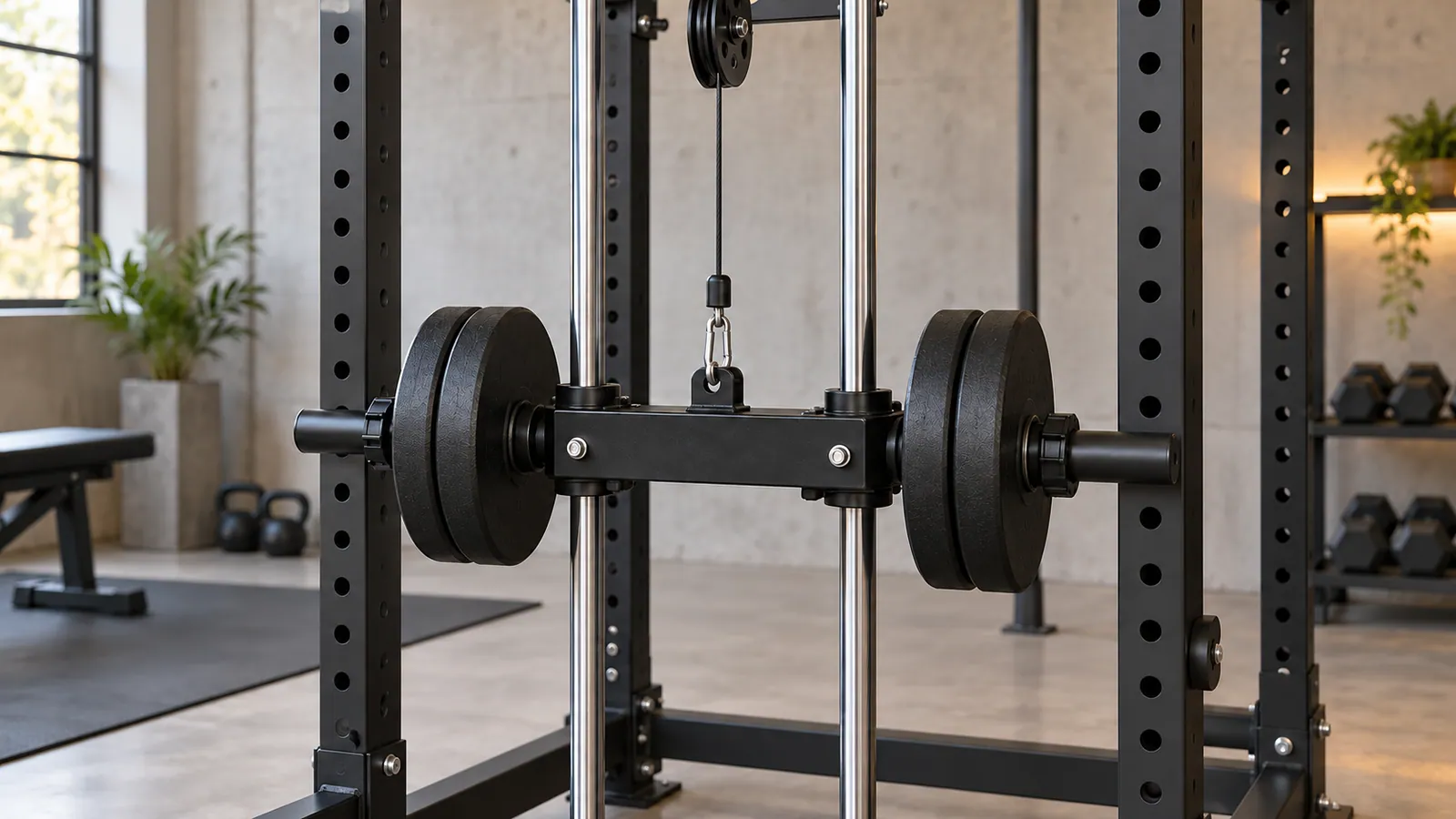
Find the loading assembly that actually moves
Start with a photograph or drawing of the cable resistance assembly, rather than the whole rack. Identify the carriage that rises when the cable is pulled and its designated loading points. Fixed storage horns keep spare plates beside the station; they are not necessarily connected to the cable resistance. A Smith sleeve is another interface again. Ask the supplier to label these separately on the configuration you are ordering.
This matters even within one trainer. Force USA’s current M10 description distinguishes the plate interfaces of its Smith bar and cable carriage. That example supports checking each interface separately; it gives no compatibility promise for a PBF Fitness model. Confirm the exact sleeve, any approved adapter and the required plate-retaining parts with your own supplier before deciding that existing plates can be used.
Measure the complete plate package, including its retainer
List the actual plates you intend to use, not just their kilograms. Record the bore, outside diameter and thickness of each type. A thick bumper and a thin iron plate with the same stated mass can occupy quite different lengths. Measure your own set or obtain its manufacturer’s dimensions; a photograph of a compact plate arrangement is a poor basis for ordering replacement plates or a cable option.
Ask how much of the loading sleeve is usable after its root shoulder, adapter arrangement and fully engaged retainer are allowed for. The exposed metal length is not automatically the loadable length. Add the thicknesses of the proposed plates and leave the space required by the approved collar or locking part. Do not gain capacity by allowing the last plate or retainer to hang beyond the intended loading area.
Force USA’s older G3 support article makes its plate-count example dependent on plate thickness. Its numerical example concerns that documented configuration, not every G3 revision or another rack. For your order, request a drawing showing the actual usable sleeve and the plate package. This is a physical-fit question; the manufacturer’s permitted load remains a separate limit, even when more plates could be squeezed onto the sleeve.
A plate that fits at rest may obstruct the travel
Check the outside edge of the largest plate and the complete retainer against the carriage’s intended path. Nearby uprights, cable runs, fixed storage and other accessories can constrain that path. Obtain the installed movement envelope from the manufacturer, including the approved plate arrangement. A plate touching a frame member at the upper part of travel cannot be solved by removing a guard or shortening the intended movement without approval.
Follow the exact loading and commissioning instructions for that assembly. Return resistance to its specified rest before handling plates, keep hands away from the moving carriage and use the required retention. If there are two loading points, confirm how the manufacturer requires the load to be distributed; do not infer a universal rule from another design. Stop scraping, tilting or a plate that shifts, and seek assessment rather than increasing the load to see what happens.
Make the plate set part of the quotation
Send the supplier the plate list, its measurements and the intended cable configuration. Ask for confirmation of the sleeve/adapter/retainer combination, usable loading length, allowable plate diameter and clear travel. Keep those answers alongside the equipment order. They let you compare two offers using the plates you actually own and reveal when a different approved plate set would be needed.
Will bumper plates always fit an Olympic-labelled carriage? The label alone is insufficient. Can an extra sleeve extension or spare barbell collar solve a mismatch? Use only an explicitly approved arrangement, not an improvised one. If the supplier cannot confirm the complete package, resolve that before purchase. A satisfactory order defines both what may be loaded and how the loaded carriage will move without interference.
- Compare multifunctional racks
- R05
- Rack Leg Extension and Curl Attachments: Will the Setup Fit You?
- Review my plate set and cable configuration