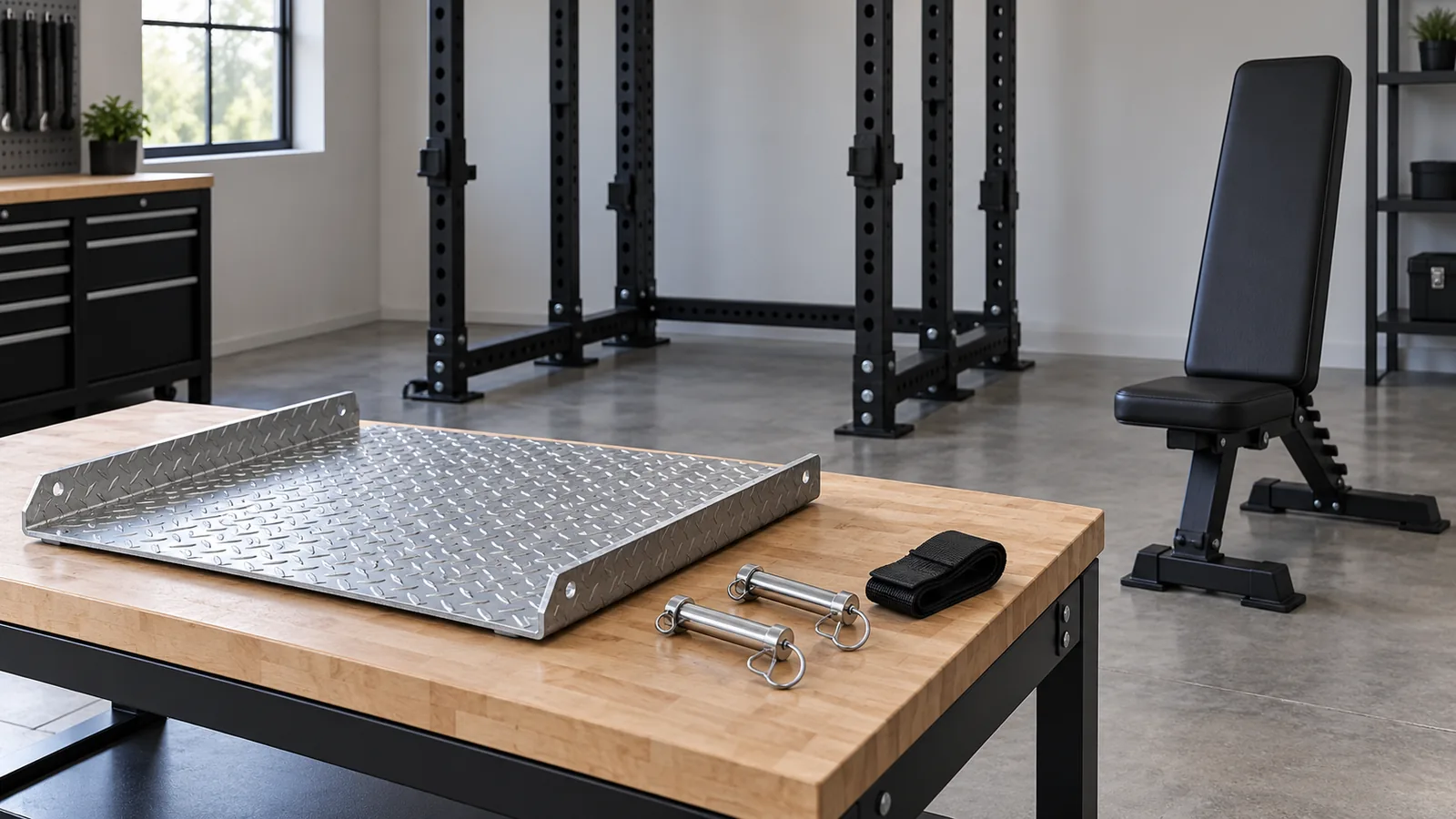
First establish which kind of leg press is being offered
Ask for the exact attachment reference and its intended operating mode. A suspended frame hanging from paired J-hooks moves differently from a footplate clamped to a Smith bar. A device that also becomes a step platform or sled can require different orientation and support parts in each mode. A photograph of the platform in one arrangement does not document the others.
Legend’s 7016 is one published example of a cage-hung module. Its guide shows a leg-press frame supported at two J-hooks, webbing retention around the uprights and separate pinned stops. Treat those as features of that system, not a set of instructions for adapting an unrelated rack. Request written approval for the proposed host frame and all supplied parts.
Keep the supports, retention and start stops separate
List what holds the moving frame, what keeps its hanging connection in the intended position and what establishes the starting or return position. These functions can involve different components. Confirm which parts are included, how they are retained and which rack mounting positions are permitted. A standard bar-catch rating does not by itself approve the J-hooks for a suspended exercise module.
The exact instructions must resolve the supported position used for loading, entry and leaving the station. Do not transfer the guide’s kickback or step-up settings into the leg-press mode. If a strap, hitch pin, stop or contact point is unclear, have the supplier identify it in the actual installation before any loaded demonstration.
Draw the moving envelope before measuring the room
Include the entire frame, footplate and actual weight plates through the approved movement. The outside plate faces and the rear loading sleeve can reach beyond the area visible from the seat. Compare that envelope with rack crossmembers, stored plates, cable trolleys and the floor. Reserve space for hands to load the attachment without entering a pinch area.
Legend specifically advises against half-rack use for its 7016 because of the space its movement requires. This illustrates why a product’s basic width or a broad rack-fit description cannot replace an operating-space review. Do not turn that statement into a universal clearance number or assume that every full cage automatically meets it.
Plan the user’s entry, exit and approach to the bench separately from the movement path. Adjacent cable or barbell training must not cross that area. Ask the supplier to show the whole station in its intended start and supported return positions, including access to the parts the user must operate.
The bench is part of the operating system
Confirm the approved bench model, backrest position, placement and method of keeping it in its prescribed location. The user presses against the footplate while supported by the bench, so bench placement is more than a comfort adjustment. A mat under a bench or a heavy-looking frame does not establish that the combination is approved for this task.
Purpose-made docking equipment can be specific to a bench and cage. Legend’s docking description, for example, identifies a matched bench with side rods, notched receivers and centring collars; it also refers to cage mounting tabs. That information does not approve a substitute bench or an improvised rope, strap or clamp. Where the proposed leg-press arrangement needs bench restraint, obtain the manufacturer’s exact solution.
Can I hang a leg press from any pair of J-hooks?
Use only the complete host-rack and module arrangement approved by its manufacturer. Hook fit and a bar-support rating do not establish approval for the different moving load and retention system.
Can the bench simply sit wherever the user is comfortable?
Its model, position, support and any required docking or restraint must follow the approved arrangement. Check entry, exit and full module travel as well as reach.
Ask for the changeover and acceptance conditions in the quote
Include the complete rack configuration, module, retainers, starting stops, bench arrangement and handling requirements in the proposal. Request the approved installation instructions and a demonstration of setup and return without bypassing any support. Record any restrictions on simultaneous use and the method for restoring the rack’s original barbell safeties after removal.
Send PBF Fitness the rack model and revision, the third-party attachment reference, its guide, the intended bench and a drawing of the loaded movement and access area. Ask whether the requested function can be supplied and reviewed for that specific project. A catalogue rack photograph does not establish the availability or approval of a hanging leg-press kit.
- Compare multifunctional racks
- R05
- Rack Cable Handles: Match the Cleaner to the Grip
- Review a rack-hung leg-press layout