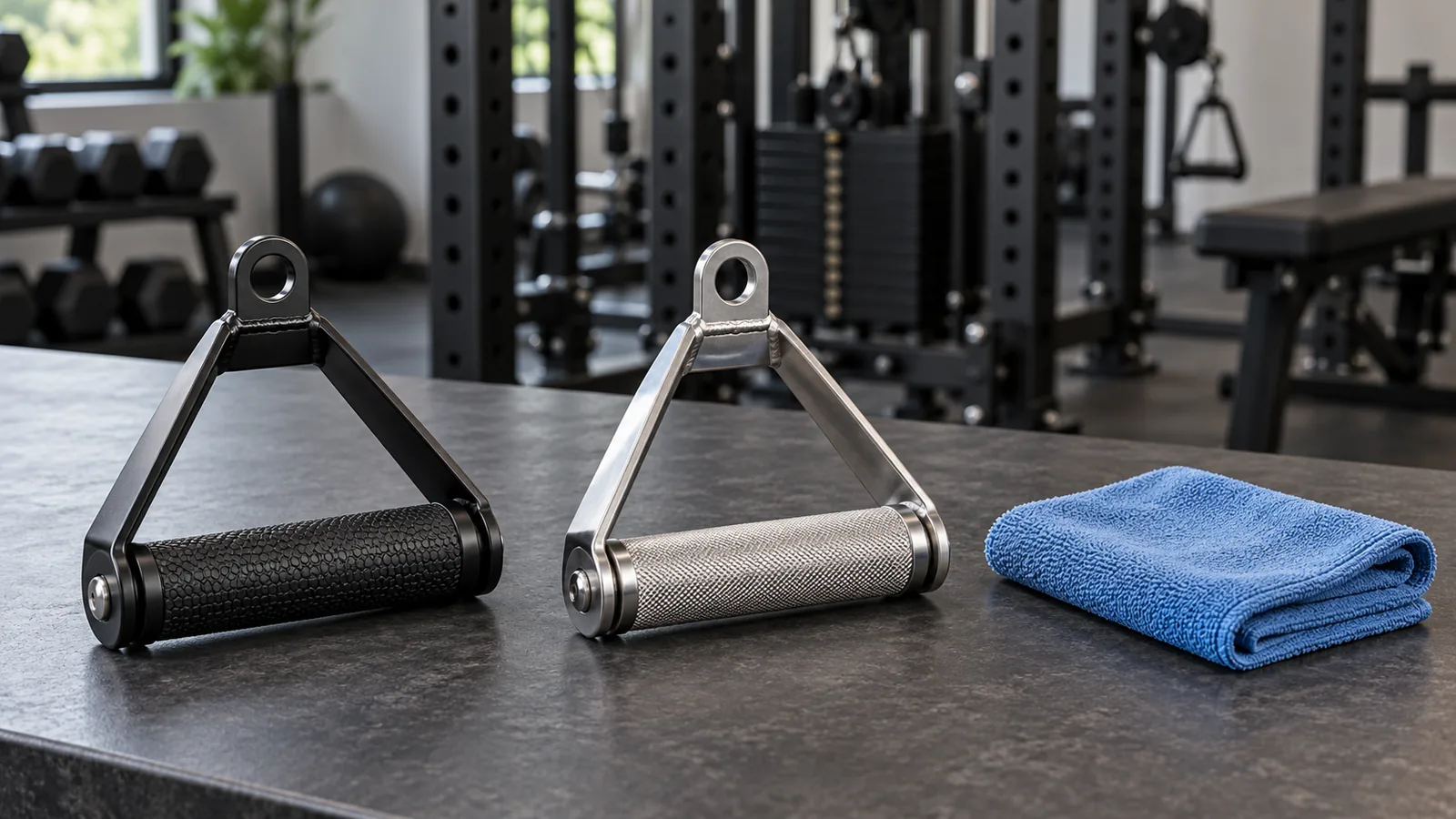
Identify the part that your hand actually touches
Start with the handle model and its care instructions. Ask the supplier to identify the grip material and finish, including any coating, bonded sleeve, foam cover or textile element. A black surface in a catalogue photograph does not establish whether the part is rubber, plastic, painted metal or another material. The frame’s maintenance sheet may cover a different surface.
Keep the detachable handle separate from the rack’s other service tasks. A guide-rod lubricant, barbell corrosion treatment or solvent mentioned for removing a sticker has a different purpose. Do not carry one of those procedures over to a hand grip because all the parts belong to the same training station.
Read two sets of directions before changing products
The equipment instructions establish material compatibility. The cleaning-product label establishes its intended surfaces and application requirements. Where disinfection is required, the selected product must suit the surface and the applicable local use; its label controls dilution, contact time and any subsequent rinse or removal. A quick wipe is not evidence that a specified disinfection process has been completed.
Life Fitness directs owners to the preventive-maintenance chapter for approved cleaners and advises applying solutions to a cloth rather than spraying equipment directly. That is a useful example of a controlled care method. It does not approve a named chemical for every third-party attachment or for a PBF Fitness rack handle. Request confirmation for the exact supplied part.
Keep the cleaning liquid away from the working mechanism
Take the station out of use for the task and let the load rest according to its operating instructions. Place a detached handle on a stable surface if its care method permits removal. Do not disconnect an attachment while it is carrying a suspended load, and do not reach into a weight stack to make room for a cloth.
Use the specified soft cloth and only the amount of product needed for the approved method. A cloth-first instruction means the spray is applied to the cloth away from the machine. Avoid soaking a rotating handle joint, clip spring, stitched edge or cable outlet. A handle that needs immersion requires its own explicit instructions; a bucket of cleaner is not a general shortcut.
Work through the full hand-contact area, including accessible end edges, without forcing liquid behind the grip. Follow the required contact and finishing stages in the chosen instructions. If the approved equipment method and cleaner label cannot both be followed, ask the supplier for a compatible alternative before using that product.
Check the grip again before it goes back on the rack
Remove residue and allow the specified drying stage. The handle must be ready for secure contact, rather than wet, tacky or coated with a slippery film. Look for splits, a lifting sleeve edge, exposed material or movement that was not part of the handle’s intended operation. A rotating grip may be designed to turn; a sleeve slipping on its core is a different condition that needs assessment.
Keep a suspect handle out of service and request its matched replacement or an approved remedy. Do not glue a loose sleeve, sand an unknown coating or cover deterioration with tape to return the station quickly. Check the connector separately under its own inspection instructions, then reconnect only in the machine’s prescribed rested condition.
Can I use the same wipe on every cable attachment?
Only where the attachment’s care instructions and the wipe’s intended-use label both support that surface and method. Foam, textiles, metal finishes and bonded grips may need different care.
Is a handle ready as soon as it looks clean?
Check the required contact and finishing stages, residue, surface condition and intended grip security. A clean appearance does not establish disinfection or repair a loose sleeve.
Make the care method repeatable for a shared rack
Record the attachment reference, confirmed surface, approved product, application method and finishing requirements where staff can use them. Store cleaned handles where they can dry as specified without collecting floor dirt or contacting oily maintenance tools. Replace an unclear decanted bottle with a properly identified product and its instructions.
For a PBF Fitness project, send the rack model, attachment photographs and reference, care sheet and proposed local cleaner. Ask which handle materials and maintenance documents belong to the actual order. This allows the equipment and cleaning process to be reviewed together without treating another manufacturer’s product list as a universal approval.
- Compare multifunctional racks
- R05
- Rack-Hung Leg Presses: Check the Bench and the Moving Frame
- Review rack handle materials and care documents