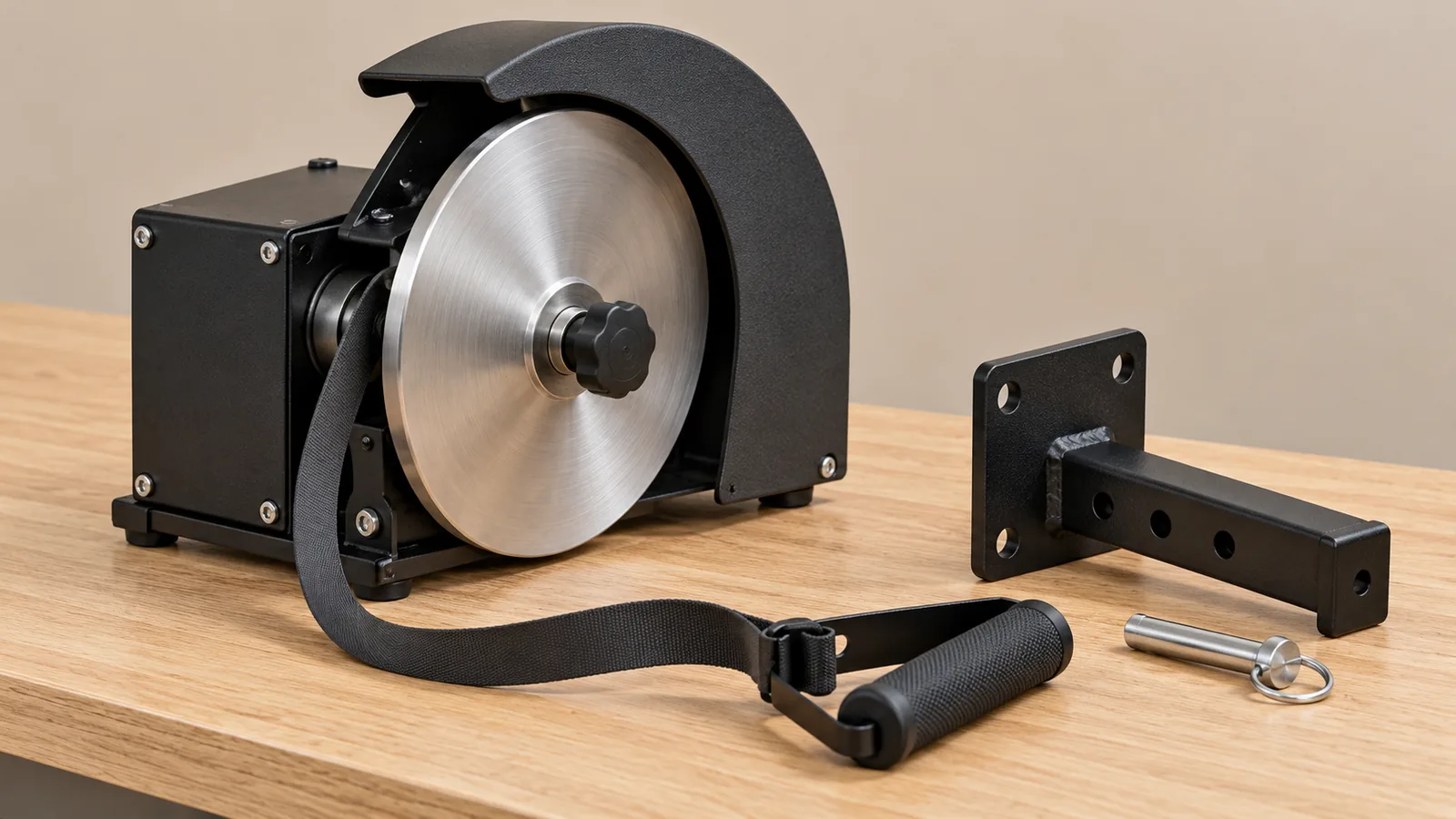
Start with the device identification
A flywheel stores rotational energy as the user drives it and returns force through its transmission. It is a different system from a weight stack connected to a rack pulley. Decide where the complete flywheel unit will mount before choosing a convenient hole or attempting to borrow the rack's cable route.
Exxentric's current comparison distinguishes strap and sized rack-mount options for its Go models from the beam arrangement of its Pro model. Its Go and Go+ also differ in belt retraction. Those details make the exact model and revision part of the installation decision; a shared family name does not make every mount or operating instruction interchangeable.
Inspect both sides of the mounting interface
There is a rack-to-bracket connection and a bracket-to-trainer connection. Confirm the rack member, mounting face, access behind it, complete fastening set and any frame installation requirements. Then identify how the trainer engages and locks onto that bracket. Verify the assembly against its current instructions rather than inferring a lock from the visible front pin.
The current kPulley Go start guide describes a rail with a red slide lock. The Eleiko Prestera kit drawing separately shows its post bracket and retaining pin, followed by the unit's rail connection. Older devices can have different hardware. Do not substitute an older Quick Lock Pin procedure or an unrelated bracket for the actual supplied revision.
If the mount shifts, the lock does not engage or the supplied parts disagree with the instructions, keep the station out of use while the supplier resolves it. Matching the upright width alone does not approve the mounting assembly, and the attachment's presence in another brand's catalogue does not establish compatibility with a PBF rack.
Reserve a protected rotating area
Identify the flywheel, shaft, securing knob and the guarding required by the particular unit. Show the full outside edge of the installed rotating assembly on the room drawing, including the guard. Keep stored plates, bar sleeves, hanging straps and passing people away from that area. Do not remove a guard to squeeze the unit between other rack functions.
Also leave the access specified for inspection and any permitted flywheel changes. A close-fitting layout that prevents checking a retainer or forces a person to reach into the rotating area is incomplete. Use the manufacturer's installation and inspection guidance for that system rather than a clearance taken from a different disc size or trainer.
Follow the flat belt out and back
Plan the drive belt and accessory through the user's entire intended movement, including the return. Check for contact with upright edges, J-cups, plate storage and other cables. The usable area includes the person's stance and movement; it is larger than the flywheel housing. Do not route the belt around an unapproved rack pulley to create another pulling angle.
Exxentric's care guidance says to stop a tangled belt, adjust its locking mechanism only when the flywheel is still and reach a full stop before disconnecting. Apply the current model's procedure and training instructions. Never release a mount or belt lock while the assembly is moving, and do not use hand contact with a spinning disc as a substitute stopping method.
Can I connect a flywheel trainer through my rack's existing pulleys?
Do not assume that. The trainer manufacturer must approve the exact transmission route and mounting configuration; a pulley designed for a weight stack is not automatically suitable for its drive belt.
Can I disconnect when I stop pulling?
Wait until the complete rotating system has stopped using the device's instructed procedure. The wheel can still be moving after the user stops actively pulling.
Plan the station's return to other uses
Agree who inspects the belt, connectors, locks and guard, where accessories are kept and how the area is left after use. If the trainer is moved between rack positions, each position needs the same approved mount, clear belt route and retained connection. Portability is not permission to attach it to any convenient rack member.
Send PBF Fitness the exact trainer and mounting-kit references, current manuals, rack details and a drawing showing rotating clearance, user travel and adjacent functions. Ask for the requested layout to be reviewed before the rack order is finalized. Keep the trainer manufacturer's installation approval separate from any general discussion of available rack layouts.
- Compare multifunctional racks
- R05
- Rack Belt-Squat Levers: Check the Rest Position Before Loading
- Check a flywheel station in my rack plan