First identify which of the two systems you are buying
One option replaces or adds a structural beam with a crossmember designed to accept climbing holds. Another uses a purpose-built grip that fixes to a specified existing rack member. These are different products. A loose climbing hold, an ordinary crossmember and a convenient bolt do not automatically make either complete system.
Rogue identifies its Monster Lite Climbing Hold Crossmembers for its named rack and rig family, with the holds ordered separately. Kodo offers a different rack-grip design with its own backing and mounting hardware. Use those examples to clarify the quotation, rather than to infer that either product is approved for a PBF rack.
A three-hole grip has more to match than its central bolt
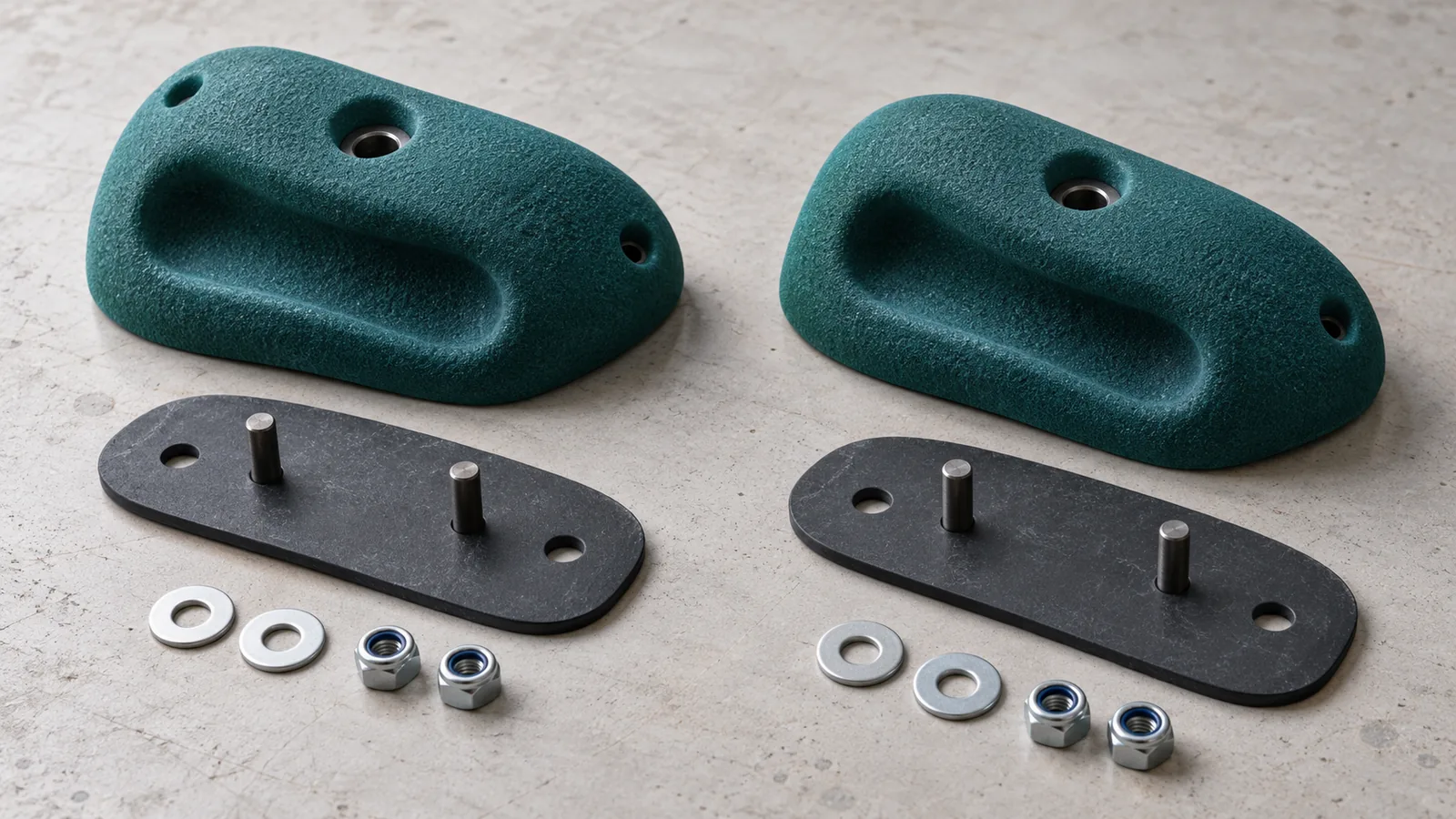
Kodo describes a jug-hold arrangement using three rack holes and integrated anti-rotation posts. Its permanently attached hardware is supplied in different bolt versions; the manufacturer says those versions cannot be interchanged. The adjacent holes therefore have a real job. Matching only the central hole diameter leaves the spacing and backing interface unverified.
Ask for the exact mounting face, complete backing contact, rear access and fastening arrangement. A nearby bracket or cable can obstruct the back of the beam even when the grip appears to fit at the front. Do not remove an anti-rotation feature, enlarge a hole or stack improvised spacers to make an unconfirmed arrangement line up.
A grip rotating under load is a reason to stop using that station and obtain the supplier's inspection and repair advice. An anti-rotation feature is not permission to ignore loose or damaged hardware. Keep the correct part identification with the station so a replacement grip is not selected on colour or bolt appearance alone.
Treat a hold beam as part of the installed rack
For a dedicated climbing crossmember, identify the rack series and the proposed beam position before discussing the holds. Confirm which structural component it replaces, whether the frame needs a particular installation or anchoring arrangement, and which bolts connect the beam to the uprights. The smaller hardware securing a hold to the beam serves another interface.
A barbell support rating does not establish a climbing configuration or approve a different direction of loading. Request the manufacturer's intended use and installation instructions for the complete station. A wall-mounted wooden pegboard is another installation again; wall instructions and photographs of home conversions do not approve attaching it to your rack.
Draw the body movement and the area below it
A stationary grip does not show the user's moving body. Map the intended hanging or traversing area, access and exit, nearby barbell sleeves, stored plates, cables and people using adjacent stations. Check the space on both faces if the system is intended to be approached from either side. Keep the climbing zone separate from simultaneous lifting activities.
Have the equipment supplier and the person responsible for the training area confirm the appropriate clear area, landing provision and supervision for the proposed use. Do not adopt a generic mat thickness, mounting height or clearance from an unrelated installation. If the actual layout cannot provide the required separation, keep the activities in different places rather than treating the rack outline as the whole working area.
Can I bolt ordinary wall climbing holds to any rack beam?
Do not assume that a matching hole makes this an approved installation. Confirm a complete system intended for the exact rack member, including its backing, fastening and anti-rotation requirements.
Send a mounting brief instead of a photo of a hole
Include the rack model and revision, crossmember measurements and hole pattern, photos of both faces, the exact grip or beam reference and the intended activity. Ask for a complete parts list that distinguishes the rack connection from the hold connection, plus the installation and pre-use checks for that configuration.
PBF Fitness can review a rack layout and the functions requested for a project. Supply the proposed climbing component and its manufacturer's requirements with that request; the existence of a rack catalogue does not establish availability or approval of this attachment. Agree the rack's lifting layout and the separate grip area before adding the function to an order.
- Compare multifunctional racks
- R05
- Rack Preacher Curl Pads: Check the Support and the Bar Return
- Review a climbing-grip proposal with my rack layout