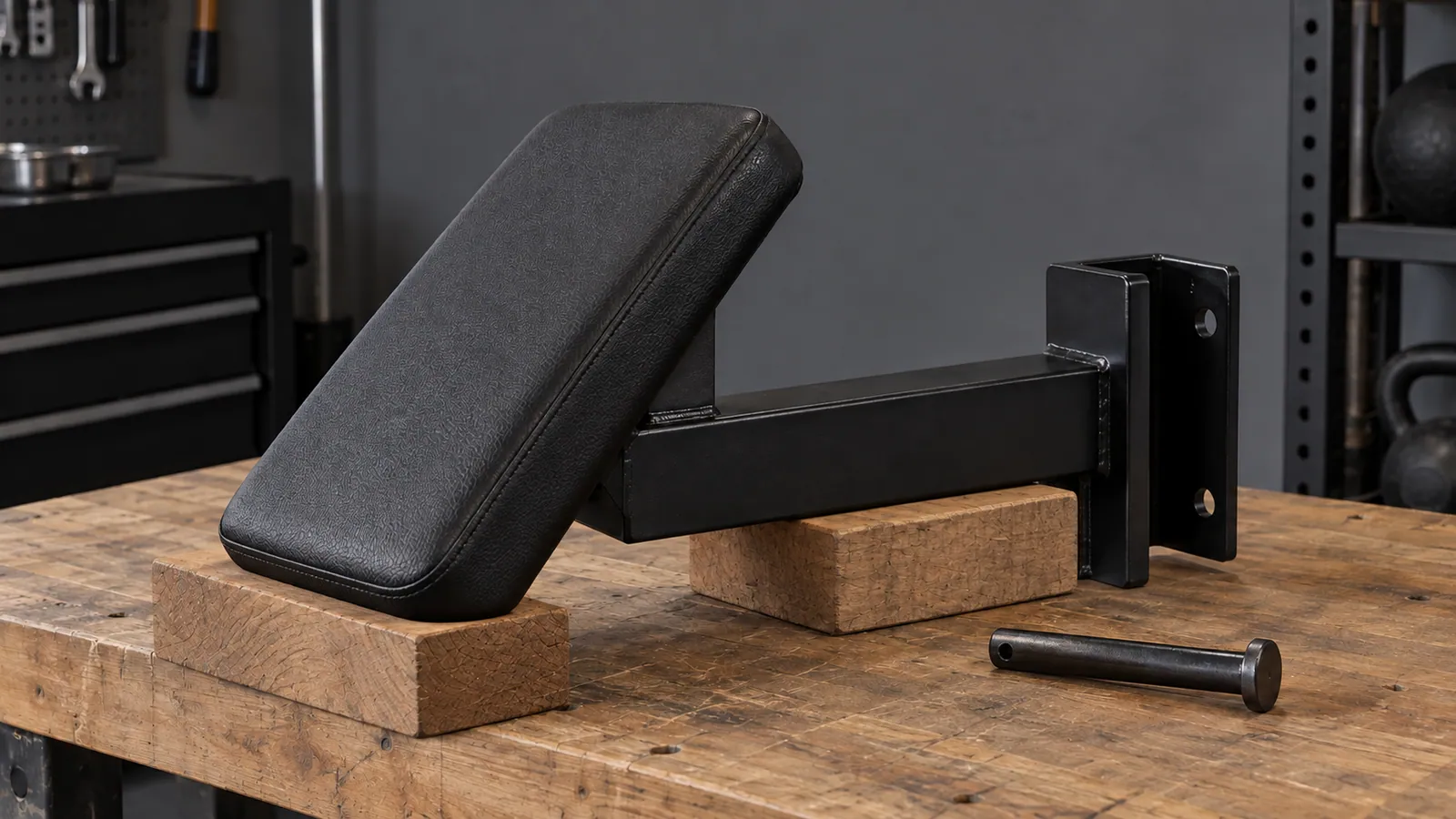
Which assembly is actually approved?
Start with the rack series and revision, the intended mounting face and the complete pad assembly. The arm, bracket, mounting pin and any separate retainer must follow that product’s instructions. An upright dimension or hole diameter cannot by itself approve an accessory that projects away from the frame.
Rogue’s Monster and Monster Lite Pritchett pads illustrate different attachment arrangements within one brand. The Monster Lite version uses its included detent pin; the Monster version describes a different clasp. Both state that the rack must be securely fastened to the floor. Do not exchange their retention methods or transfer that example into a PBF approval.
Determine separately what provides resistance: a compatible landmine, free weights or a permitted cable arrangement. A pad photograph does not mean these items are supplied, or that every outlet and bar combination will work. Ask for the full configuration in the quotation.
Can the user reach through the intended movement?
Record useful pad height, inclination and projection from the upright, together with the user’s stance and hand position. The person should be able to establish the intended contact without stretching around a frame member. Do not assume mounting at a different hole also changes the pad’s angle; some designs have separate adjustments and others do not.
Consider pad shape as well as width. A broad surface may support the torso yet crowd the upper arms. A narrow surface may leave another user unable to establish the intended contact. Use the maker’s permitted setup and an approved assessment rather than interpreting more padding as automatic comfort.
Trace the beginning and end of the row. Check the handle, elbows, bar sleeve and actual plate diameter against the pad arm, rack base and storage. A clear resting position does not establish a clear moving path. For a landmine arrangement, bar length and pivot location belong in the same plan.
Will the station work between sessions?
Include the route to grip the implement, the return position and removal of the pad. Its working projection may occupy space also needed for free-bar lifting or cable work. A shared rack needs a practical changeover and a suitable place for the removed assembly, not only a compact storage photograph.
Keep the claims modest. Chest support can change how a row is arranged, but it does not establish a therapeutic result, remove all loading from the back or make every heavier lift appropriate. User comfort, technique and intended use remain relevant.
Give PBF Fitness your rack configuration, proposed rowing implement, body-fit requirements and room sketch. Request confirmation of the complete approved mount, installation conditions and movement envelope. If those points cannot be demonstrated for the combination, compare another documented configuration before ordering.
- Compare multifunctional racks
- R05
- Heavy Cable Handles on a Rack: Keep Control During Weight Changes
- Review my rack and chest-support layout