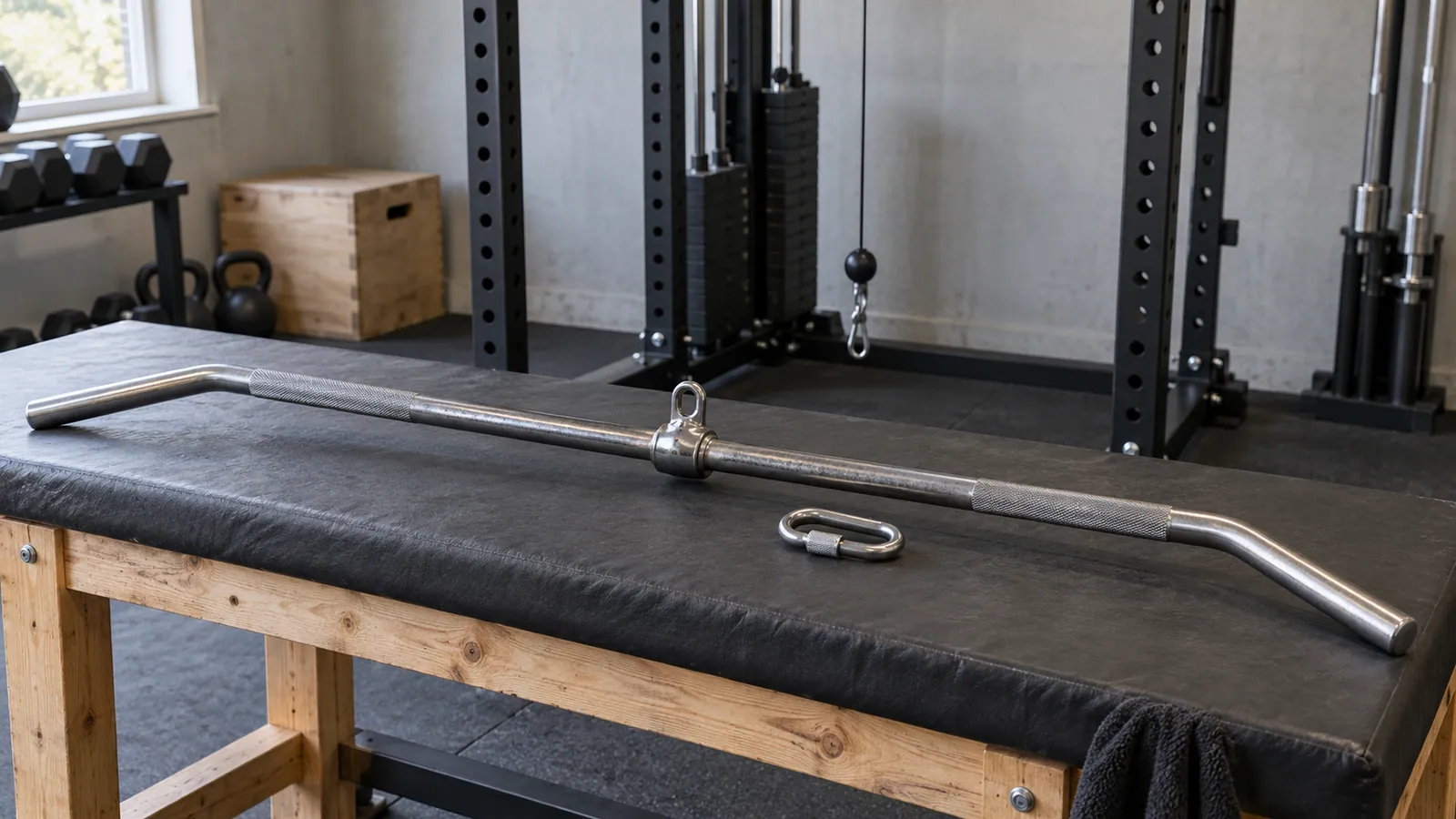
A handle has weight before you select a training load
A solid lat bar and a fabric strap can behave differently on the same outlet. The handle’s own mass acts through the cable even between sets. Do not infer balance from a stack label or from how a different station behaves. The relevant question is what happens during the exact changeover your manufacturer permits.
Rogue’s lat-bar instructions require the attachment to remain supported during weight changes and provide a visible warning label. That requirement describes control of the accessory, rather than permission to remove a selector from a raised stack. Read it alongside the station’s selection procedure; neither instruction cancels the other.
Prepare the change before opening the connection
Stop the movement, retain control of the handle and bring the equipment to the prescribed rested condition. Keep fingers clear of the stack, pulleys and connector pinch points. Follow the manufacturer’s order for selection or removal. If maintaining support leaves you unable to complete that order, stop and obtain a method suitable for the actual assembly.
Lay a removed handle on a stable, suitable storage surface rather than leaving it where a person can step on it or where it may roll. Do not add selected plates simply to keep a handle aloft. Do not force a loaded selector, clamp the cable or make a hanger from a safety pin. These changes introduce another load condition.
Check a new handle at the real outlet
Ask whether the proposed handle, connector and terminal belong together. Check the reach needed to support the accessory during changeover, particularly at a high outlet. A connector that closes is only one part of suitability. A long bar can be awkward to hold while another task must be done, even when its exercise grip is comfortable.
Keep pulley ratio, handle mass and stack markings as separate information. There is no universal subtraction that determines whether a handle will remain parked: different cable systems and their unloaded resistance behave differently. A claim that an accessory is lightweight does not establish a safe change procedure for another machine.
Include the routine in the purchase decision
For a shared rack, compare how often users change a wide bar, a short handle and individual grips. Confirm where removed parts go and whether the prescribed operation can be performed without reaching into moving components. An approved lighter handle may be more useful than a heavier one that makes every transition difficult.
Does a stationary handle prove the setup is safe? No. Its apparent balance may change with configuration, and a damaged connector still needs attention. Does supporting the bar allow a raised-stack pin change? No. The stack must meet the station’s stated conditions before selection changes.
Send PBF Fitness the rack model, cable outlet, handle identification and the changeover you need. Request confirmation of compatible parts, permitted support or parking and the correct selection routine. The R05 product page describes an equipment option; it does not approve an unrelated accessory or an improvised procedure.
- Compare multifunctional racks
- R05
- Rack Chest-Support Pads: Will the Rowing Setup Fit You?
- Check handle changeovers for my cable rack