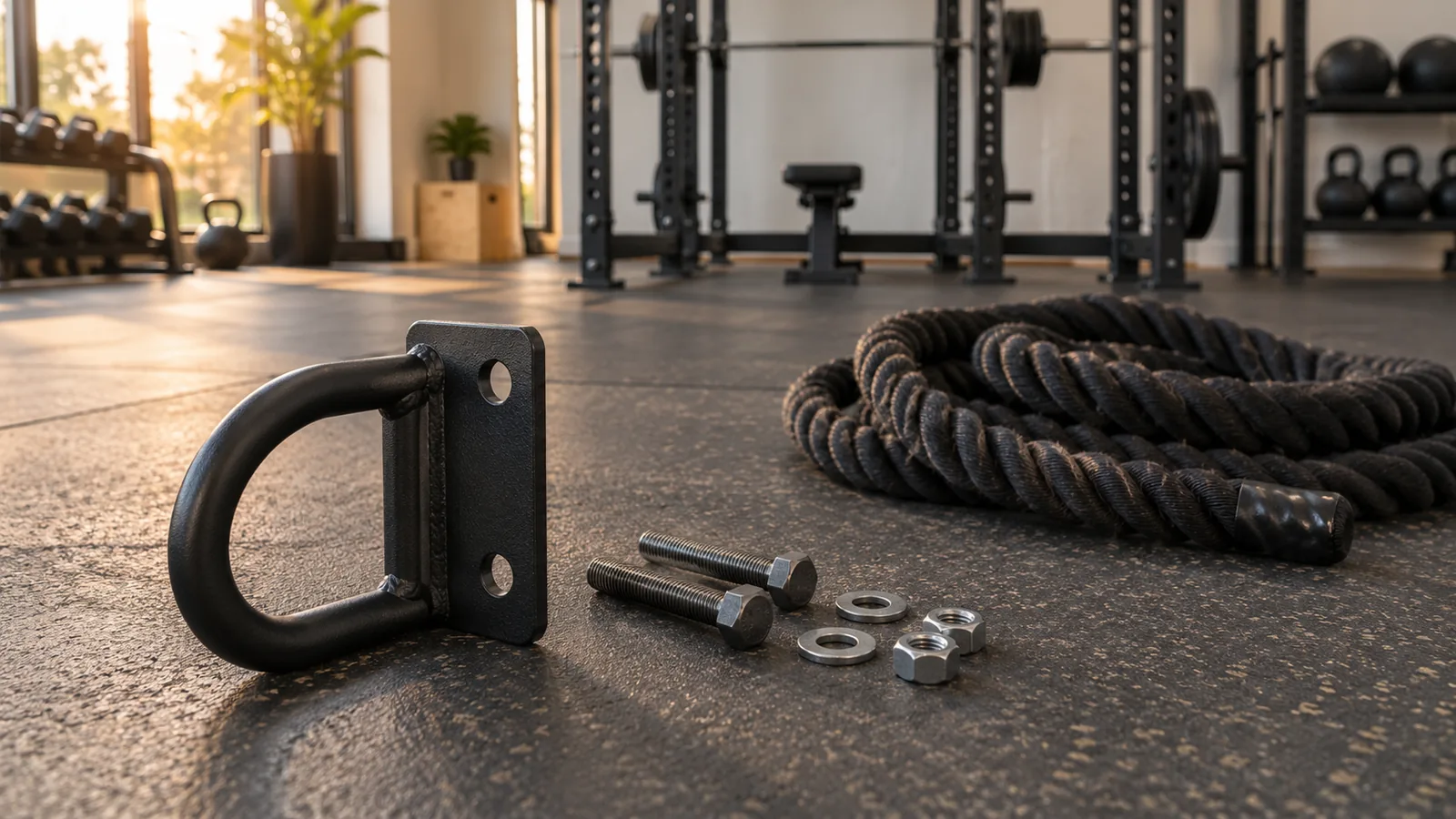
Start with the anchor's stated purpose and rack version
Conditioning ropes repeatedly move against a fixed contact point. Select a fitting intended for that use, with the actual rope and installed rack identified. Storage horns, J-cups and spare frame holes should not become anchor points through convenience alone.
Manufacturer limits can include a rack generation as well as a series name. Titan's T-2 anchor page, for example, specifies a production-date boundary for compatible racks. Rogue distinguishes its ML/Infinity and Monster arrangements. These are reasons to request the exact part match, not dimensions to transfer to another brand.
Confirm the complete installation, including the rack
Use the prescribed mounting face and complete fastening arrangement. Rogue's ML/Infinity drawing changes a bolt choice for a particular upright face; a bolt that reaches through the steel is not the only installation check. Obtain the actual drawing and tightening instructions for your combination.
The anchor does not override the rack's floor or wall installation requirements. Have those conditions confirmed with the supplier and site installer before planning rope work. Adding stored plates or choosing a low attachment position is not a substitute for required anchoring or an approved rack configuration.
Draw the lane that the rope will occupy
Lay out the rope, user position and intended wave pattern within a clear floor area. Account for sideways motion, the rope's contact with the floor and the route people use to pass the station. Check nearby cable handles, benches, stored equipment and the rack's other active stations.
A route that is clear while the rope lies still may cross a lifting or walking area once it moves. Decide which station will be available during rope use. Follow the rope maker's layout guidance instead of treating a frame footprint or catalogue rope length as the complete space requirement.
Inspect the contact point and respect its limits
Use the specified direct rope contact or approved connecting arrangement. Look for a rough contact surface, damaged rope sheath, loose fasteners or movement of the anchor assembly. Stop the station and obtain the maker's repair decision when its condition is unclear; do not hide a fault with an improvised sleeve or knot.
Intended use remains part of the decision after installation. Rogue explicitly excludes climbing ropes for its conditioning anchor. Permission for waves or slams does not establish permission to suspend a person, attach a climbing rope or use the same part for another loading direction.
Can I use any wall or floor rope anchor on a rack?
A wall or floor mounting approval does not establish rack compatibility. Confirm the exact rack-mounted arrangement and required hardware with its manufacturer.
Does a smooth-looking ring mean the rope contact is suitable?
Appearance alone is insufficient. Check the anchor's intended rope contact, the rope maker's connection instructions and both components' condition before opening the station.
Make the quotation describe an operating station
Send PBF Fitness the rack reference and revision, proposed anchor location, rope details and a simple floor plan with adjacent activities. Request confirmation of the approved complete assembly, installation conditions, contact method and inspection instructions. This lets the supplier assess a usable station rather than an isolated metal fitting.
- Compare multifunctional racks
- R05
- Rack Split-Squat Rollers: Check the Mount Before the Height
- Review a battle-rope station for my rack