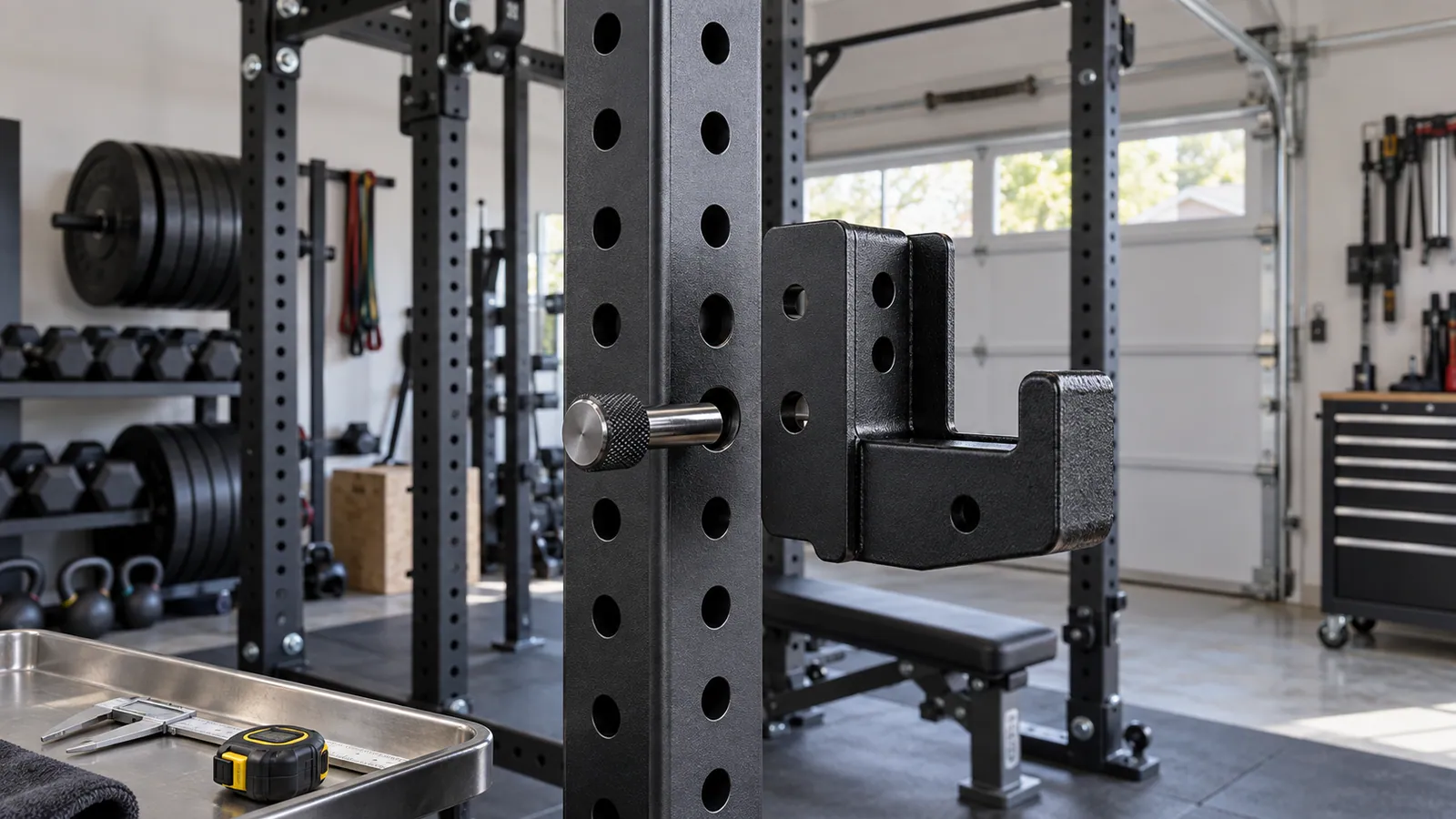
Measure the interface, not the category name
Begin with the rack manual and a measured drawing.
Record upright width and depth, wall thickness where relevant, actual hole diameter, center-to-center spacing, hole pattern on every face and distance from the upright end to the first hole.
Separate simple pins from structural systems
A 1-inch pin cannot be assumed to fit every rack advertised with 1-inch holes, and a 5/8-inch family is not a universal standard.
Coating thickness, tolerances and metric equivalents can change fit.
Single-pin accessories such as a utility seat or storage peg still need bracket and pin clearance. Two-pin, wraparound and crossmember-mounted attachments also depend on hole phase, face spacing and rack depth.
Create a compatibility record before ordering
Cable kits, Smith attachments and weight stacks are complete assemblies. Their pulleys, guide rods, crossmembers and travel limits make cross-brand substitution far more restrictive than swapping a J-cup.
Do not drill, enlarge holes, force a pin or use an improvised spacer on a load-bearing attachment unless the rack and attachment manufacturers provide a documented method.
For a compatibility review, send the rack model, measured upright section, hole diameter and spacing, photos of all mounting faces, attachment model and intended load direction. Keep the approved combination in the equipment record.
- Compare multifunctional racks
- R05
- Counterbalanced vs Non-Counterbalanced Smith Machine: Which Fits Your Rack?
- Compare rack safety options