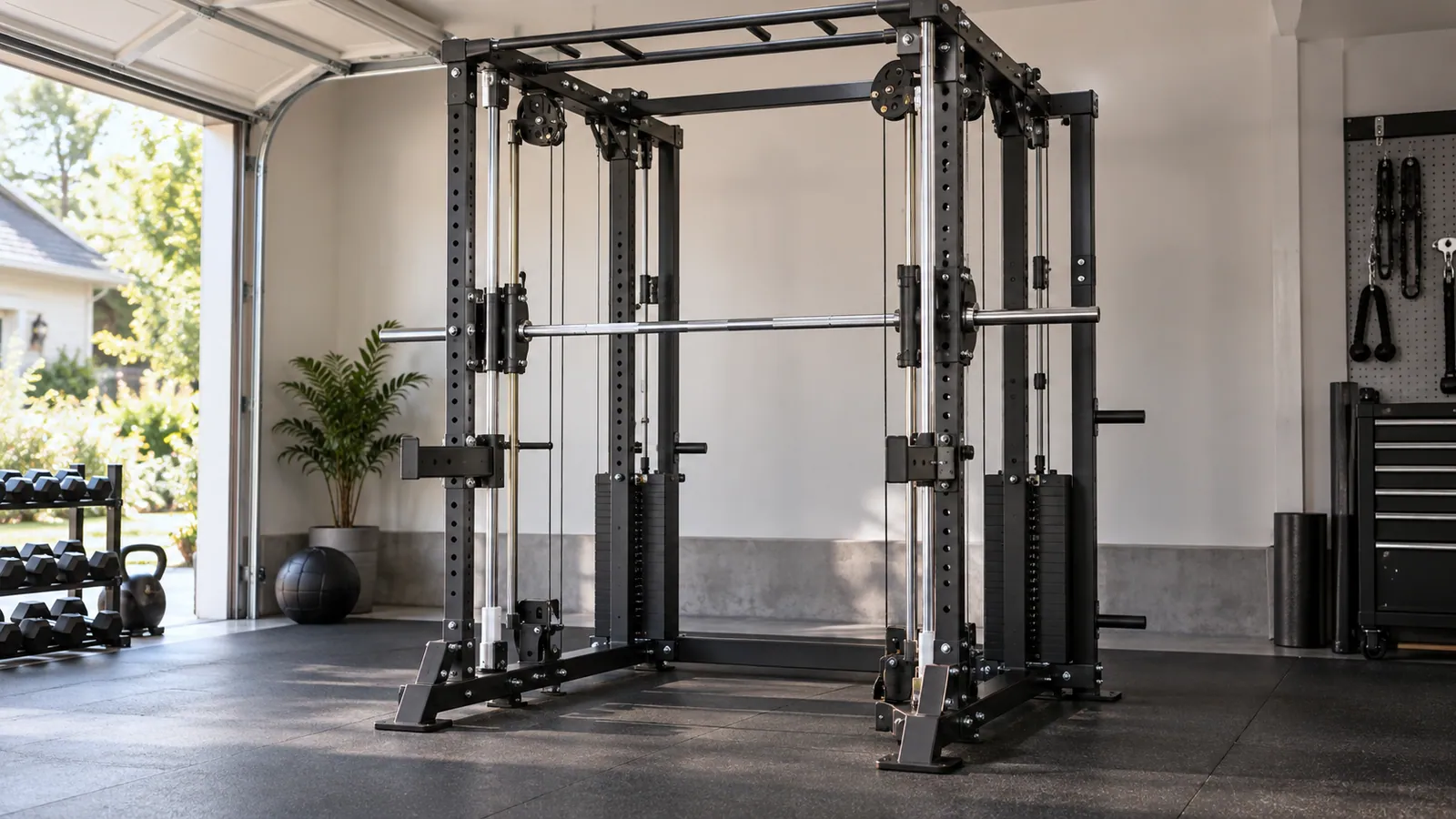
Start with the weakest planned movement
Counterbalance matters most when the empty carriage is already too heavy for the intended user or exercise.
Shoulder presses, split squats and rehabilitation-style work may expose this limit sooner than heavy squats.
Do not infer starting resistance from the visible bar alone.
Compare the complete moving system
The carriage, hooks, guide system, counterweight, cable routing and friction all affect what the user feels.
A lower starting load expands exercise and user options, but it does not define smoothness, capacity or safety. Guide alignment, bearings or bushings, stop positions and usable travel remain separate checks.
A non-counterbalanced design can be simpler and may feel more familiar to experienced lifters, yet the empty moving mass must still suit every planned movement.
Specify, test and record the real setup
Ask for the effective starting resistance of the exact configuration and how it was measured. Record plate load plus stated starting resistance when tracking training; do not transfer numbers between different Smith machines.
Before purchase, test the lightest planned exercise, the lowest and highest stop positions, full travel under a light load and access for inspecting cables, pulleys and guide components.
- Compare multifunctional racks
- R05
- Power Rack Hole Size and Attachment Compatibility: 1 Inch, 5/8 Inch and Metric
- Check rack depth for your room