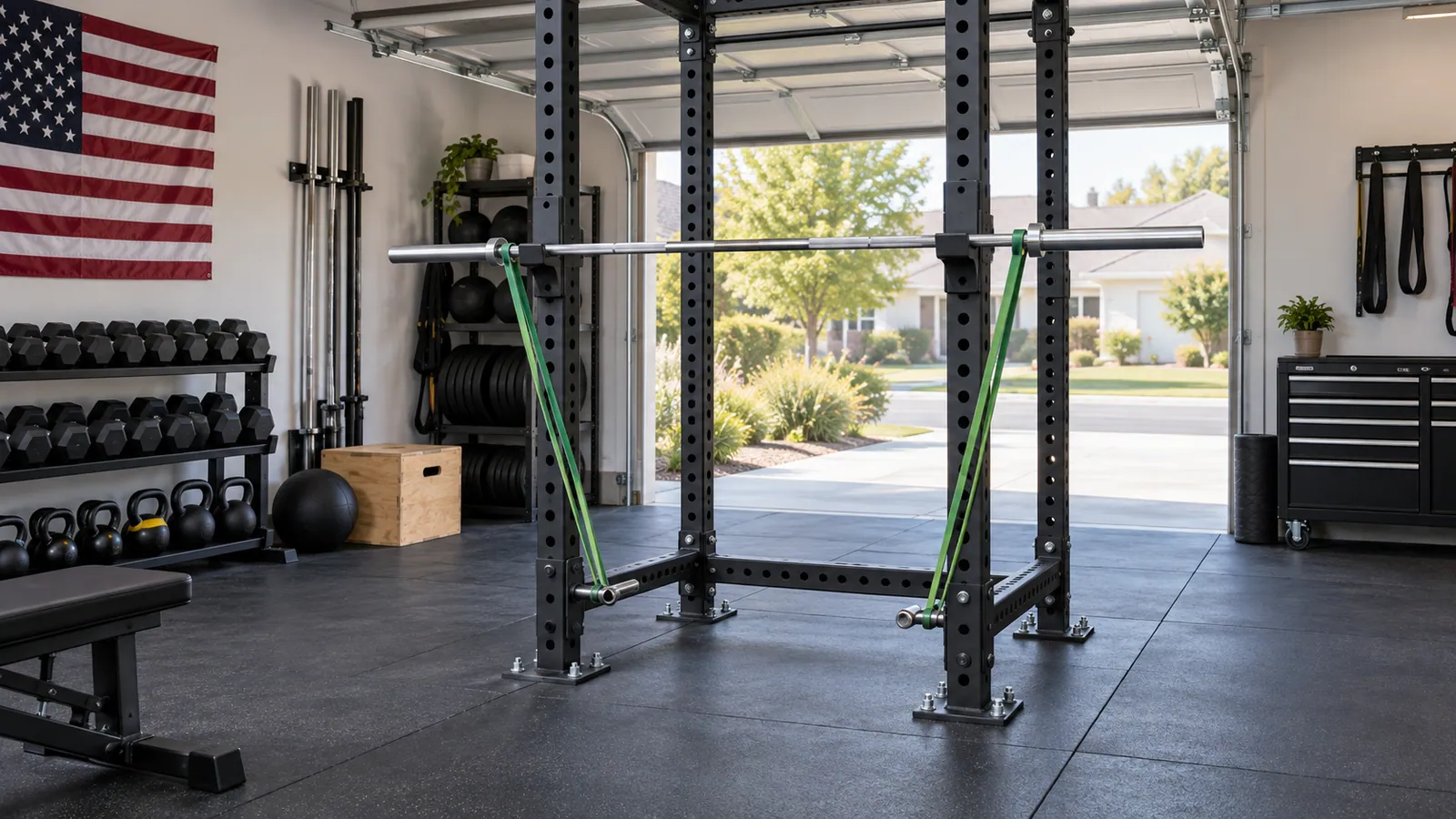
Confirm the rack can accept band load
Band resistance rises as the band stretches, so the rack receives changing force in addition to the bar load. The setup must be treated as a system, not as two loose pins.
Some racks omit band-peg holes because their mass or base design is not intended for banded lifts. Never drill the frame or assume an attachment fits from tube size alone.
Build a symmetric band path
Check the approved mounting face, hole diameter, peg diameter, usable projection, retaining feature and clearance behind the member.
Use matched bands of the same model and condition on left and right. Route them symmetrically and remove any band with cuts, cracking, glazing or permanent deformation.
Keep the band line away from plate horns, bolt threads, cable trolleys and the lifter’s feet. A smooth peg cannot compensate for abrasion elsewhere in the path.
Test the complete setup before training
Anchor or stabilize the rack exactly as its instructions require. Stored plates are not an automatic substitute for floor anchors.
Before loading, pull each band through the intended range with an empty bar and watch the rack, pegs and retention. Stop if a peg walks out or the frame shifts.
When specifying a rack, document the planned movements, band lengths, highest attachment position, anchoring method and clear floor area so the supplier can confirm the configuration.
- Compare multifunctional racks
- R05
- Power Rack J-Cup Liners: When Should You Replace Them?
- Compare rack safety options