Start with one real workout, not the catalogue
Write down three cable exercises you actually intend to do, the working resistance for each and whether another person will share the machine. Then walk through the changes between them. A slow loading process matters much more during alternating sets than during a session built around one movement.
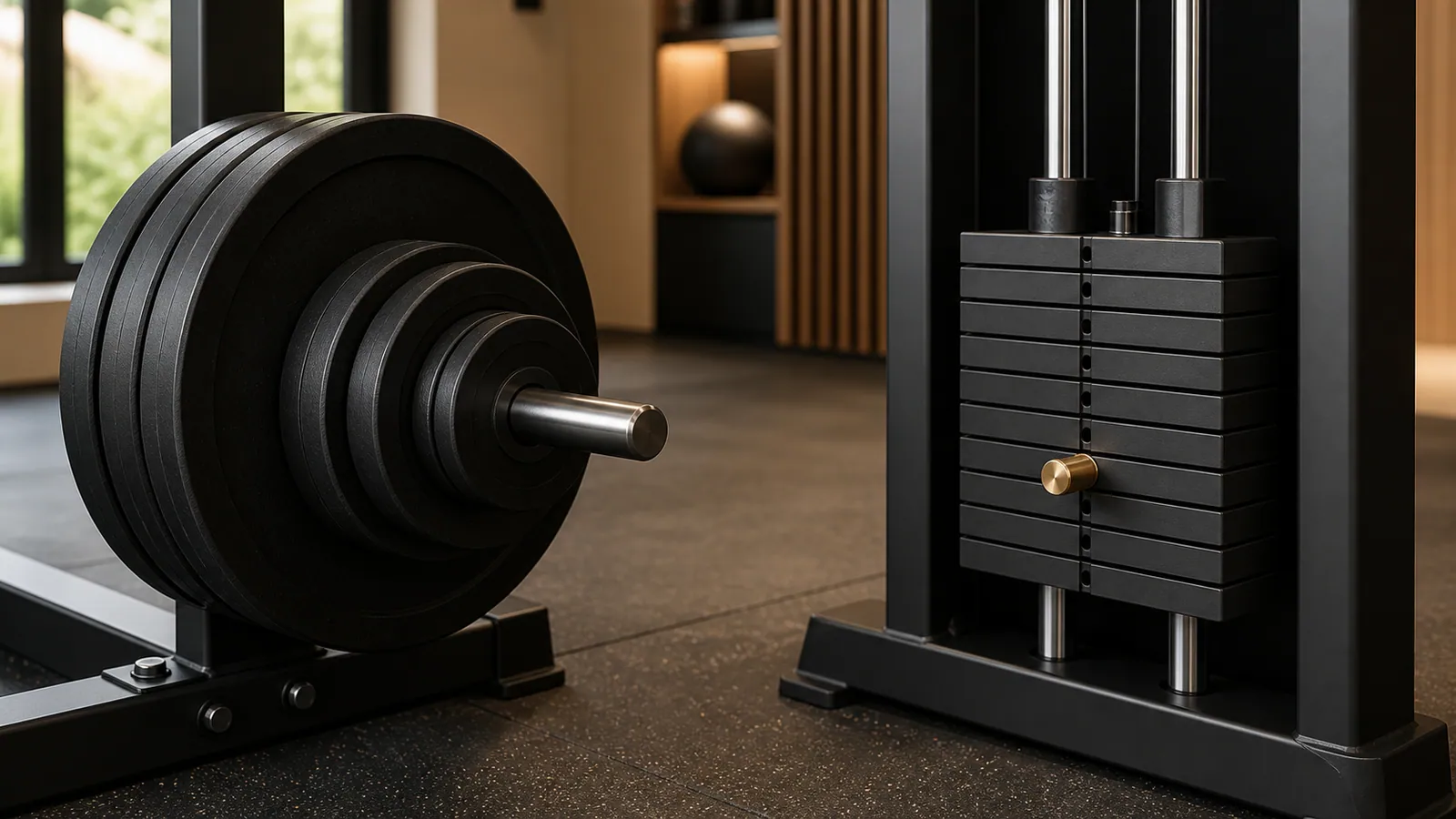
A selectorized system changes resistance using its supplied selection mechanism. A plate-loaded system requires you to move separate plates onto the designated loading points. Neither description tells you the cable ratio, available travel, starting resistance or whether the two handles have independent loads. Those are separate questions.
Already own plates? Check what 'compatible' includes
Measure the plate bore and check it against the specified loading sleeve. Also compare plate thickness with usable sleeve length. Owning enough kilograms is not the same as being able to fit that load onto the machine, particularly when thick bumper plates fill the sleeve early.
Include the required collars, storage and handling space in the setup. Plates stored behind a rack are inconvenient when that rack is close to a wall. Ask for the operating envelope with plates installed, rather than assuming the unloaded frame dimensions describe every part of a workout.
- Confirm sleeve diameter and usable loading length in the model documentation.
- Check the permitted load for that cable station, not only the rack's overall rating.
- Follow the specified balanced-loading and retention procedure.
Compare the cost of a usable system
An inexpensive frame can become a different purchase once plates, collars, storage, delivery and assembly are included. Conversely, a weight-stack option can avoid buying a duplicate set of plates that would otherwise move constantly between the barbell and cable station.
| Your situation | A useful comparison |
|---|---|
| Plates already available | Fit, loading access and competition with barbell exercises |
| Several users alternate | Speed of safe load selection and independent cable stations |
| Light isolation work | Minimum usable resistance and approved adjustment increments |
| Future expansion | Written upgrade compatibility, parts and installation requirements |
A bigger stack is not automatically a heavier handle
Compare resistance at the handle using the manufacturer's stated cable arrangement. Different ratios can make the same selected mass feel different. Do not add both stacks together to advertise a single handle's load unless that specific machine is designed and documented to combine them.
For smaller movements, examine the starting load and the size of each change. An approved add-on weight can be useful on a compatible system; hanging loose plates from a selector pin is not a substitute. Keep selection pins, attachments and loading methods within the manufacturer's instructions.
Do not buy an upgrade on a verbal promise
Some manufacturers offer a matched conversion between plate loading and stacks; others do not. The existence of a kit for another rack does not establish compatibility. Ask for the exact kit reference, supported frame version, added dimensions, parts list and assembly procedure before treating a future conversion as part of the purchase.
Bring a training brief to the comparison
For a PBF Fitness configuration enquiry, send your three main cable exercises, existing plate dimensions, room plan and budget. Request the available loading system, handle resistance information and included accessories for the exact proposed model. This produces a useful configuration comparison without assuming that every rack offers every loading option.