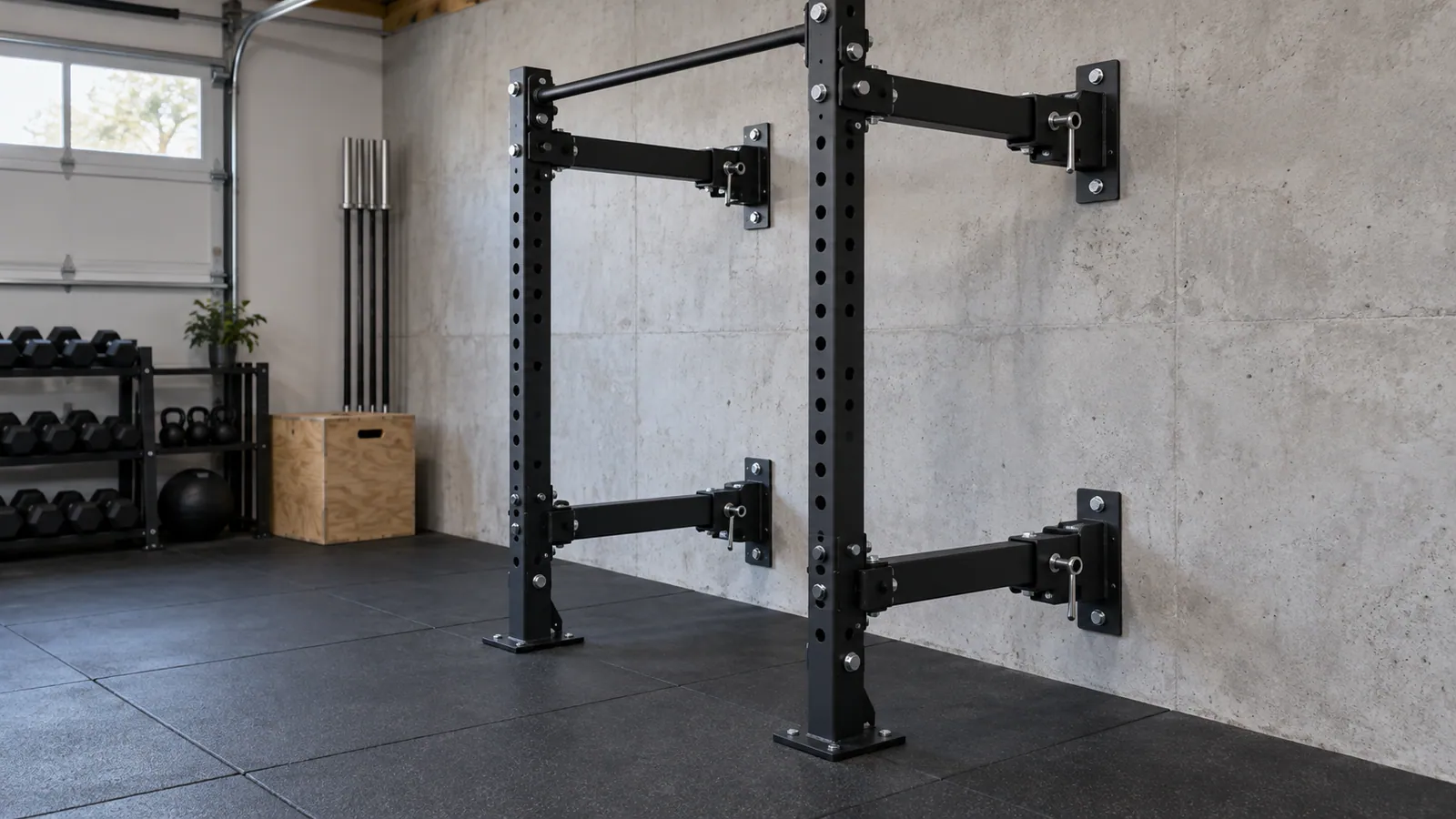
Treat opening as a change of configuration
A folding rack moves between a storage state and a working state. Those states may use different pin positions, and a removable pull-up bar can have its own retention. After the rack has swung away from the wall, pause before adding a bar or starting an exercise. The question is whether the specified working configuration is complete, not whether the uprights look approximately square.
Keep the manufacturer’s operating instructions at the equipment. Identify the exact model and revision, including any fitted accessories that affect the opening or closing procedure. A wall-installation handover establishes the mounting arrangement; it does not replace the recurring check after somebody has removed a bar, pulled a pin or folded an upright away.
Give each piece of hardware its own job
Locate the hinge or pivot fasteners, the pins that hold the open position, and the retention for removable members. A bolt through a hinge can remain fitted while the rack swings. A position pin prevents that particular movement in the designated state. A pull-up bar retainer secures the bar connection. Finding one of these in place cannot stand in for checking the others.
Rogue’s RML-3W manual separates locking the crossmembers into the working position from retaining its Quick Attach Pull-up Bar. Its instructions also identify the pull-up bar’s own pin retention. This example explains why a generic instruction to “check the pins” is incomplete. It does not establish the number, diameter or location of pins on every folding rack.
Map those functions using your own manual, rather than importing a sequence from a similar-looking rack. Rogue’s R-3W and RML-3W belong to different families. Other manufacturers can use a different mechanism again. Do not remove a hinge bolt to imitate a detachable position pin, or replace a specified retainer with loose hardware simply because it enters the hole.
A lock must engage without forcing the structure
Check that each specified lock is fully seated and retained in the approved working position. Keep the swing area clear and hands away from pinch points while moving the frame. If a pin will not align, stop and investigate under the manufacturer’s procedure. Hammering it in, drilling the hole or pulling a loaded frame into alignment hides the cause rather than confirming readiness.
Confirm the support and stability specified for the installation. The RML-3W manual calls for floor-supported uprights and a stability check before each use; that instruction belongs to its documented arrangement. For your equipment, look for unsupported feet, movement at a connection or a configuration that differs from the approved setup. A pin visibly inserted into an unstable frame does not resolve those conditions.
Closing needs its own operating instruction
Before folding, follow the exact instructions for unloading and removing or repositioning the parts that obstruct the movement. Do not assume that every folding rack permits plates, a bar, safety attachments or a removable crossmember to remain in place. Keep the storage position and its retention distinct from the exercise position; storing a pin beside the rack is not the same as installing it for the next use.
If your team cannot identify which hardware locks the working state, obtain a labelled model-specific procedure before the rack returns to service. For an equipment enquiry, provide the model, fitted accessories and photographs of both deployed and stored positions. Ask for the required checks and the approved response to a missing or binding pin. That gives each person opening the rack a definite readiness decision.
- Compare multifunctional racks
- R05
- Replacement Rack Safety Straps: Match the Whole Catch System
- Clarify the rack deployment procedure