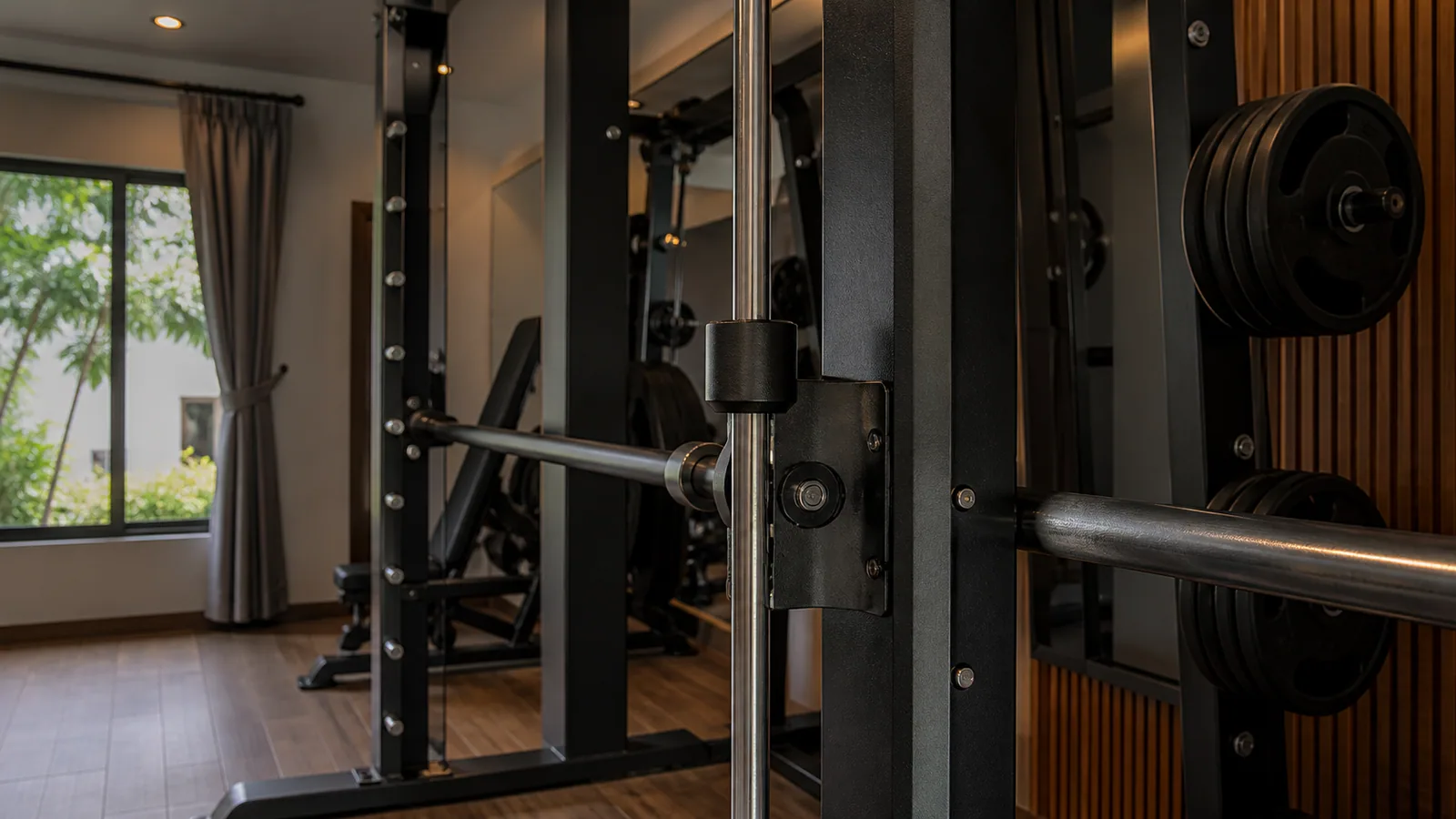
A rack that looks heavy can still move when a user applies force high on an upright or away from the center of its base. The reliable question is not whether all power racks need bolts, but what the complete configuration requires in the room where it will be used.
| Check | What to confirm | Who confirms it |
|---|---|---|
| Equipment requirement | Exact model and every extension | Manufacturer manual |
| Use pattern | Exercises, attachments and pull direction | Owner or coach |
| Structural substrate | Slab, thickness and concealed services | Local installer or engineer |
| Property permission | Drilling, waterproofing and lease rules | Owner or building manager |
Start with the manual for the complete configuration
Ask for the installation document that matches the quoted model, including cable modules, plate storage, rear extensions and stabilizer feet. A flat-foot rack, a narrow four-post cage and a wall-mounted system do not send forces into the floor in the same way.
When the instructions specify anchors, anchor size or a fixing sequence, those requirements are part of the product installation. Adding plates to storage pegs is not a substitute unless the manufacturer explicitly documents that arrangement.
Map the forces created by the planned exercises
A static squat inside the frame does not load the rack like kipping pull-ups, band pegs, a landmine, a lever arm or a cable pulled away from the base. List the movements, accessories and direction of force before judging stability.
Published load capacity describes a specific component or test condition; it does not automatically describe resistance to tipping in every direction. Treat stability and load rating as separate checks.
Inspect the substrate, not just the visible flooring
Rubber tiles, timber, laminate or ceramic protect and finish the room, but an anchor must engage a suitable structural material. Before drilling, a local professional should confirm the slab, useful depth, underfloor heating, pipes, waterproofing and any post-tensioned construction.
Renters and apartment owners also need written property approval. If drilling is not permitted, the safe response may be a different rack format—not an improvised fixing method.
Commission the rack after assembly
On a level surface, verify four-point contact, squareness, fastener sequence and every stabilizer with the rack unloaded. Then check the actual bench path, bar loading zone, cable travel and accessories at controlled force.
Stop using the rack if it rocks, slides, lifts at a foot or repeatedly loosens hardware. Correct the floor, assembly or anchoring cause and repeat the inspection before loading it again.
Send a room brief that produces a usable answer
Include the exact product code, room length and width, ceiling height, floor photos, known floor build-up, intended exercises, accessories and whether drilling is allowed. PBF Fitness can confirm requirements for the supplied configuration; the building professional remains responsible for the anchor and substrate selection.