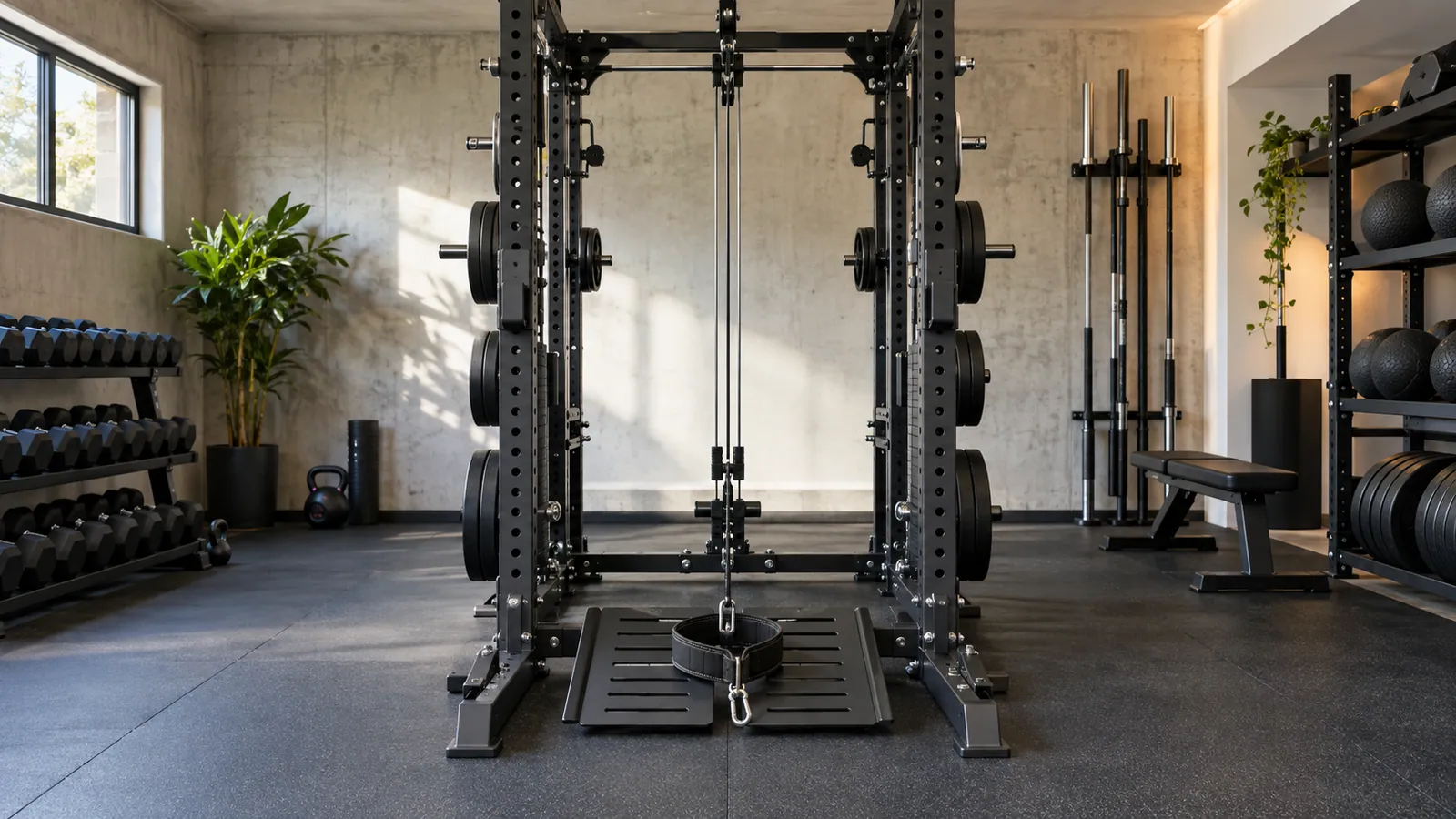
Trace the force line from belt to stack
Cable belt squats need a near-vertical pull beneath the lifter rather than a long diagonal from a distant low-row outlet.
The exit point, platform opening and standing position must keep the cable centered through the full repetition.
Solve depth and entry as two separate problems
Cable length controls both squat depth and the height at which the belt can be clipped.
A system can reach depth yet leave the user crouched during connection, so entry and full travel must be tested separately.
Measure the distance from pulley exit to belt connection at standing height and at the deepest planned position. Include carabiners, chain links, belt straps and any riser platform in the calculation.
Approve the complete configuration
Inspect the cable at slow speed without load before adding resistance. Stop if it touches the platform, walks out of the groove, pulls the trolley sideways or reaches its travel limit.
Confirm the published limits and approved attachment method for every load-bearing part. Do not infer that a cable, pulley or accessory inherits the rack frame rating.
Plan a stable hand support and a deliberate disconnect procedure. Select this setup only after height, cable path, platform, user stance and warranty compatibility are documented; send those measurements for a configuration check.
- Compare multifunctional racks
- R05
- Are Jammer Arms Worth It on a Power Rack? Check These 7 Details First
- Compare rack safety options