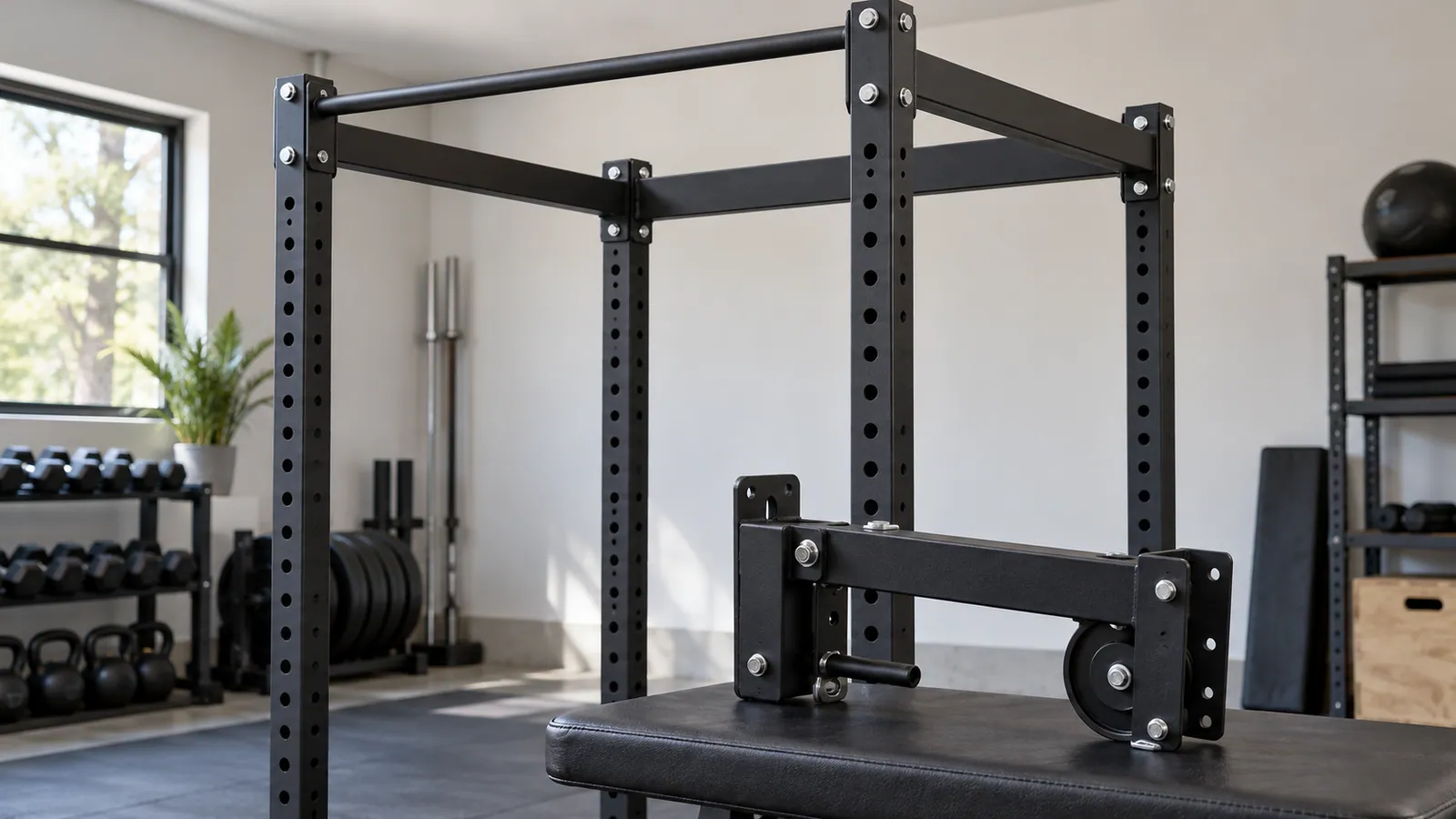
Order a configuration, not a loose attachment
Write down the rack series, actual upright height, frame depth and current top arrangement. Add the exact expansion model and revision. The question is whether those parts form an approved assembly together, not whether two bolt holes appear to line up.
Ask which pull-up bar stays, which structural member changes and which parts arrive in the kit. Include spacers, brackets and required base components in the quotation. This makes a later expansion decision visible before a dealer orders an attractive but incompatible top bar.
A grip option can change expansion compatibility
Multi-grip or projecting bars occupy space around the top of the rack. Their brackets can also share the area needed by a cable module. A straight bar is not automatically compatible either; exact placement and the maker’s configuration remain decisive.
Manufacturer instructions sometimes require replacing a member with a supplied brace. That is an engineered configuration change for the stated rack, not permission to leave a brace out or rotate a different bar until the module clears. Keep every required support in the approved arrangement.
Check the assembled envelope and fixed cable path
Use the final assembly drawing to identify the highest bracket or pulley, rear projection and fixed cable routing. Measure from the finished floor to the lowest actual obstruction, in inches or millimeters consistently. Rack height alone does not describe an expansion’s complete installed height.
Also review pull-up headroom, handle access and space to assemble and service the module. A fixed crossmember clearing the pulley housing does not prove the handle and user can move freely. Keep the maker’s structural compatibility check separate from your room and movement measurements.
When the proposed combination is not approved
Choose a supported bar or expansion package, retain the current rack without the module, or select a different complete system. Drilling, moving a brace to unused holes or removing a support creates a configuration that the catalog has not established. Stop before assembly when the parts list and drawing disagree.
Can a dealer’s photograph settle it? Only an exact identified configuration backed by the manufacturer’s instructions can resolve the parts decision. Send PBF Fitness the model, current top photos, intended module and measured room envelope. Request a written layout, complete conversion list and installation instructions before purchase.
- Compare multifunctional racks
- R05
- Rack Cable Snap Hooks: Does the Gate Close Securely?
- Review my rack’s planned cable expansion